
Today's Take for July 10, 2026
The main story: The EU is demanding that Meta change the design of its Facebook and Instagram apps to remove “addictive” features like endless scrolling. Since 2024, the über-regulator of Europe has been investigating Meta for breaches of its Digital Services Act, a massive set of rules designed to rein in the power of tech giants operating on the continent. Preliminary findings released today found that Facebook and Instagram’s infinite scroll features and autoplaying of videos put users’ minds on autopilot, lulling them into a trance. Meta now has a choice to make: either restrict those features or face a fine of up to 6% of its global revenue. Ouch.
Why it matters: Anyone who’s lost an afternoon scrolling through Reels knows that yes, they absolutely can be addictive. But the EU actually made that against the law. The DSA was designed to help swing the balance of power away from the US’s seemingly untouchable tech giants, placing them under regulatory oversight. Aside from the US itself (whose current administration is notably buddy-buddy with Silicon Valley) the EU may be the only regulator big enough to succeed. This case will be a major test of its power – and the tech sector’s exposure to it.
What this means…
- For Meta: Another bad day in court, and one that’s joining a lengthening list. In March, the company lost lawsuits in New Mexico and California over its platform design, one that determined it misled customers on children's safety from predators, and another for causing mental health harms to an individual. It may have taken a while, but the Meta's “move fast and break things” approach to users' brains may finally be catching up to it.
- For investors: It's a sign that Meta is exposed to some serious regulatory risk, even if investors are mostly shrugging it off. Meta's violations of the DSA come with a maximum penalty of 6% of its global revenue – and that includes revenue from AI. If Facebook or Instagram runs afoul of the EU, the whole company will pay, and the stock price will reflect that.
- For EU-US relations: A bold salvo from Europe, and one that may well prompt a response from Washington. When the EU drafted these laws back in 2022, it received pleas from the Biden Administration to expand its focus beyond just US tech companies. They didn’t, and now there’s a whole different guy in the White House.
- Bottom Line: As far as shocking moments in the tech sector go, Europe demanding Meta nerf the design of the world’s most popular social media apps ranks way up there. If this doesn’t show up in Meta’s stock price, that’s a clear indication that the AI narrative is still drowning out everything else.
The Wrong Question
Headline: Canada added 18,000 jobs in June, according to a new StatsCan report.
Everyone's asking: Could a student job boom help pull Canada out of its recent hiring funk?
The better question: What do these new jobs actually pay, and how stable are they?
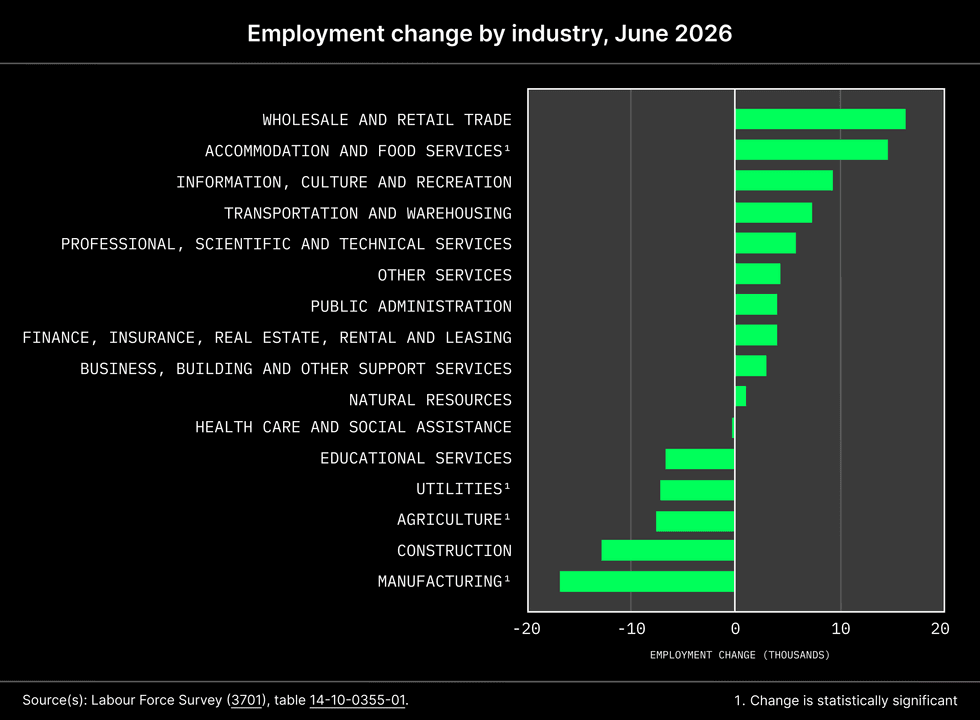
Stats Can's latest jobs report shows employment in wholesale and retail is up, while jobs in manufacturing are way down.
Statistics Canada
Why it matters: A graph buried in the report shows that employment gains in retail, wholesale, accommodations, and warehousing offset big declines in manufacturing and construction. Which is nice if the replacement jobs came with similar pay, hours, and protections – but mostly, they don't. Going from a unionized job at a Ford plant (with a wage floor, benefits, and seniority protections) to a part-time gig stocking shelves at a fulfillment centre (where you might have to pee in a bottle) is quite the adjustment. If the labour market swaps enough of one job for the other, then job numbers technically go up while workers lose ground on pay, hours, and security.
Also missing: Signs of mass layoffs in the tech, media, or IT sectors (for June, anyway), which you might expect if the whole "AI taking jobs" thing was happening. Things that make you go hmm.
Quote of the Day:
“Engagement is not endorsement.”
Who said it and when: Mark Carney, on a July 9 visit to Saudi Arabia.
Why it matters: Carney entered Saudi Arabia on a proverbial tightrope this week, balancing his new “take the world as it is” approach to global affairs against the more activist tradition of Liberal foreign policy under Trudeau. Back in 2018, Saudi Arabia ejected Canada’s ambassador from the kingdom after Global Affairs Canada subtweeted the Saudis over their arrest of several women’s rights activists. Saudi Arabia's human rights record hasn't improved much since then, but there’s also this whole Iran thing now. At a time of a ton of global instability, Carney’s principled pragmatist approach is being put to the test.