Correction (Sept. 1, 2026): This article originally cited Trinity St-Paul's 2024 rental revenue and occupancy costs as reported on its tax filings. After publication, the church provided more specific figures. The piece has been updated to reflect those numbers.
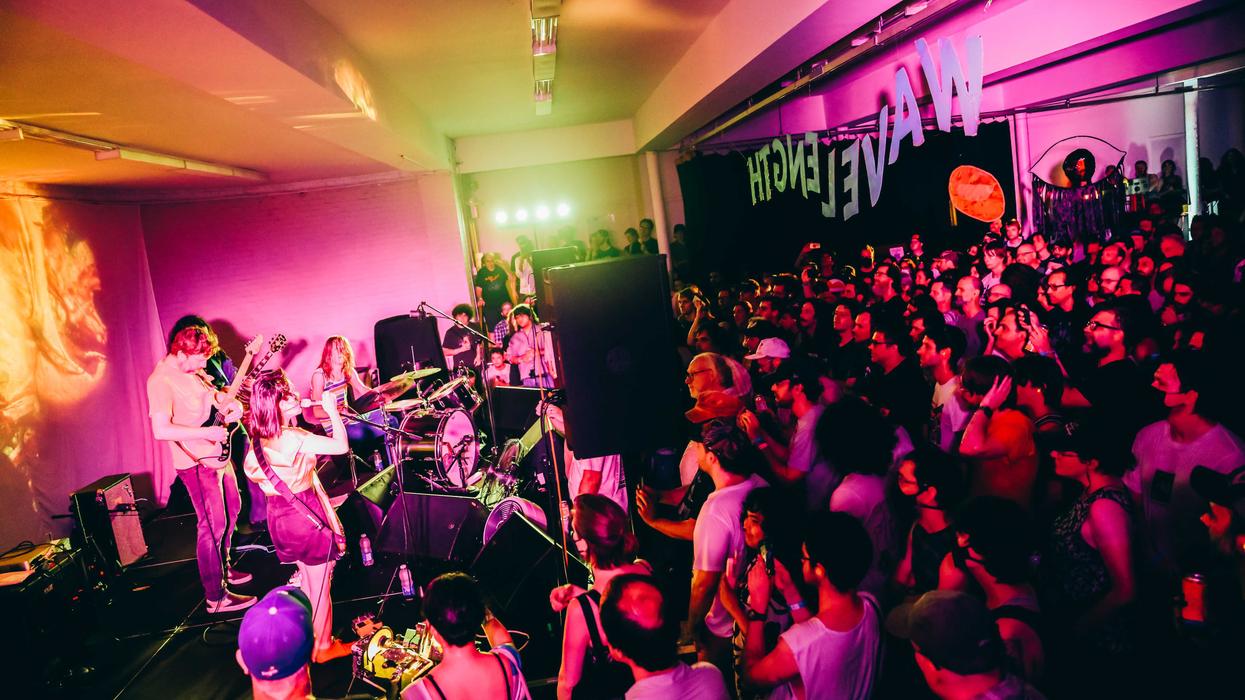
If you didn’t know better, you’d think this was a club. The audience crowds towards the stage, packed cheek to jaw in the dimly-lit space, the lack of light accentuating the trippy projections behind the band – Japanese-American art rock pioneers Deerhoof. It's a big deal to see them here – this is the only Canadian venue on the tour, and their latest album came out to solid reviews. Yet this isn't one of the city’s renowned stages, like Sneaky Dee’s or the Horseshoe Tavern, nor is it a major stadium like RBC Amphitheatre or Scotiabank Arena. Nope. This is a church basement, complete with blank white walls and fluorescent lights, transformed into a place where magic happens.
Those lucky souls who got to see Deerhoof up close at this June 2025 show can thank Wavelength, the non-profit artists’ collective that put on the show, and regularly hosts events in the parish hall of St. Anne’s Anglican Church in Toronto – in this case, in the basement. Across the city from that church, another has long held wrestling matches in its two-level basement gym, performers in stretchy singlets suplexing each other in a temporary ring. (Wrestlers include Luigi Primo, an aggressively Italian pizza maker who fights while twirling a pan of pie dough, which he whips at them as a finishing move.) Yet another, Lawrence Park United, recently rented out its gym space for a film shoot, in which a sopping wet Hudson Williams dripped all over a Peloton.
Other churches have opened their entire spaces to revellers, allowing their more sacred spaces to be used for fun, if secular, purposes. Last year, the sanctuary of Trinity St-Paul’s United Church in downtown Toronto was briefly transformed into a “Mushroom Church”: an artist filled it with fungi, hooked the plants up to synthesizers, and translated their tiny electrical impulses into music. Nearby, the Church of the Holy Trinity, has hosted techno raves.
In the year of our Lord 2026, churches are becoming some of the best places to see innovative new acts in Canada. As the congregations worshipping within them get ever smaller, and the buildings they own get more expensive to maintain, churches across Canada are looking for innovative ways to make some extra cash. One option is to undergo drastic redevelopments; another is to make better use of the space they have already. The result has been a proliferation of new and unexpected synergies in recent years, with weirder and more wonderful acts taking over the basements – and, in some cases, the holy sanctuaries themselves. From amateur wrestling to acid rock concerts, there’s a whole economy chugging along in (and under) sacred spaces.
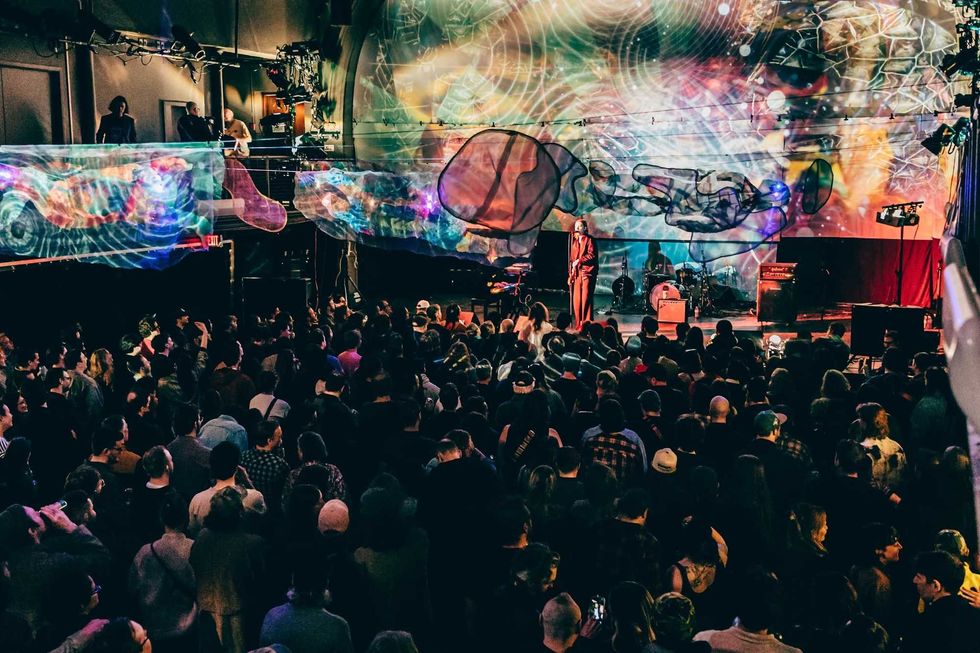
With its soaring ceiling and balcony area, the upper floor of St Anne's parish hall serves as a more traditional concert space.
Green Yang
These unusual mashups are the product of some ruthless economics. Churches may not have to pay taxes, but there’s no escaping upkeep, especially when it comes to buildings that are often over a century old. One study has found that 3,250 land-owning churches across Canada are experiencing multi-year deficits and have less than three years of cash reserves in the tank. These churches have no money, but plenty of space.
Meanwhile, an entirely different sector has capital to spend, but no spaces to spend it in. Despite the public remaining more than willing to splurge on entertainment, cities across Canada have been bleeding concert venues. A 2019 report for Toronto City Council noted an “alarming number” of concert venues had shut down in recent years, and this was before the pandemic. In the years since, several other prominent venues have disappeared across the country, including 648 Kingsway in Vancouver, Blue Dog Bar in Montreal, and The Dream Cafe in Penticton, BC.
Related: "Joy is non-negotiable: Why Canadians can't stop spending on concerts"
That's bad news for revellers, worse news for the economy: the same City of Toronto report estimated that its local music venues generated more than $852 million in Gross Provincial Product (GPP), and nationally, the numbers are far greater. A 2023 study by the Canadian Live Music Association found that the nation’s 3,750-odd venues contributed $10 billion annually to the country’s economy and supported over 100,000 jobs. There’s a lot to lose if those places can’t stay afloat.
Enter the church basement.
“It’s a black box theatre in a way,” says Bunce. “But it also has a sort of DIY, punk rock, Berlin techno bunker vibe to it.”
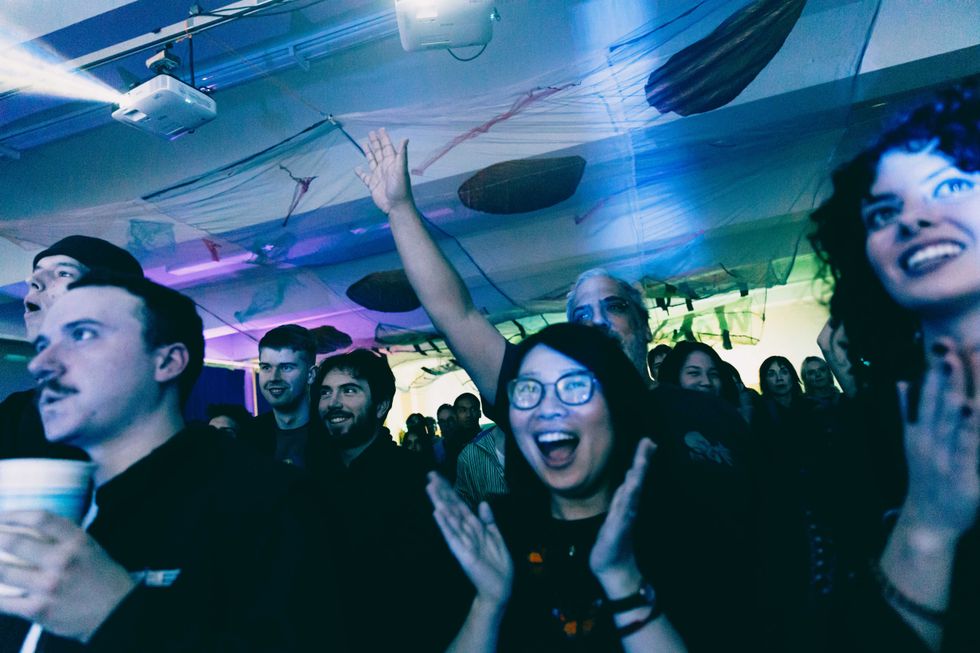
Crowds go wild in the St Anne's basement space.
Green Yang
Wavelength had been around since 1999, and for most of its life lived a nomadic existence, hosting shows at various venues around town. But when Toronto began emerging from the pandemic in 2023, its organizers noticed it was harder to get people out of the house than it used to be. “We were sensing a lot of reluctance from audiences to really explore new spaces,” says Jonathan Bunce, Wavelength’s artistic director. “There was more desire for familiarity and regularity.”
That put them into the position of a would-be tenant looking for a forever home, which in turn was a litmus test for the real estate around them: where could a long-running festival organizer find a permanent home? “We’re in a space crisis,” says Bunce. “It’s at a premium here, given the cost of commercial real estate.”
As a result, Bunce’s mind went to the least likely place: the basement of St Anne’s, which was among the 13 different venues they’d hosted shows at that year. Bunce was already in love with the upstairs space, a church-like hall with a high, domed ceiling. But the subterranean floor had proven impressively versatile, thanks to its 14-foot ceilings and an elaborate curtain system left behind by another organization. “It’s a black box theatre in a way,” says Bunce. “But it also has a sort of DIY, punk rock, Berlin techno bunker vibe to it.”
In other words, it was the perfect spot. That year, Wavelength laid down roots at St Anne’s, becoming an official tenant organization of the church, and have since rebranded as Wavelength at St Anne’s to honour their host. Beyond just the space itself, however, having a church as a landlord also made for a good deal on rent. Bunce declined to say exactly just how much his organisation was paying, but he did call it “affordable.” Especially in Toronto, that means something.
The pews don’t come out, but it still gets very, very loud – perfect, Dawson says, “for people who don’t mind sitting down and having their minds blown.”
It was this line of thinking that led Aaron Dawson to welcome a heavy metal festival into the main hall of Trinity-St Paul’s, a 137-year-old church in downtown Toronto. Before his current post as the site's building manager, he worked as Wavelength’s GM, which helped provide plenty of connections in the city’s music scene. So when the organizers of Prepare the Ground approached him, asking to rent the upstairs sanctuary space for a festival of heavy music, he wasn’t as opposed as one might expect. It helped that the event goes beyond the traditional head-banging you might first associate with the genre. “You can’t really have a mosh pit,” Dawson says. “We don’t have the space, and it’s a soft-seater theatre.” The pews don’t come out, but it still gets very, very loud – perfect, he says, “for people who don’t mind sitting down and having their minds blown.”
Trinity St-Paul’s got into the venue business 20 years ago, Dawson says, when it realized it would need another income stream to keep up with maintenance costs. In 2010, it hired its first general manager (the same role Dawson now fills) and several full-time staff to deal with the venue-booking business. As the owners of a space with a 700-seat sanctuary, Dawson and his staff are going a fair bit beyond the basement game (the downstairs is still used for traditional AA meetings) but they’re filling the same niche in the market.
As a non-profit themselves, Trinity St-Paul’s is to offer its space at a deep discount, with rentals going for $318/hour – far lower than comparable venues like Massey Hall or the CAA Mirvish Theatre. “It’s been a challenge for us trying to find the sweet spot where we’re affordable to the community while also covering out very expensive costs of maintaining this big, old building,” says Dawson. Making that work has meant expanding to the kinds of events that wouldn’t normally walk through their big wooden doors. Dawson’s music contacts helped in that regard. “I really tried to spread the word,” he says, and it worked. The church has seen "an upsurge in pop, rock, folk, metal, and world music” events paying to rent the space.
Those new friends have paid dividends. In 2023, the most recent year audited financial statements are available, Trinity St-Paul’s earned $736,985 in rental revenue, nearly enough to offset their $762,798 in occupancy costs, which include building upkeep. That rental income was their single-greatest source of income, greater even than tithes and donations themselves. Draft financial statements for the past two years show that, while a roof repair project pushed the church building $145k into the red in 2024, revenues from rentals exceeded upkeep by $23k last year. Spotty as the profits may be, hosting concerts is keeping the church alive.
“If you’re trying to evoke a specific feeling from people, putting challenging art in beautiful spaces is a good way to do it.”
Ironically, however, the closer the shows get to the pulpit itself, the more expensive they tend to be for promoters. While the sanctuary rooms may come complete with a pipe organ and stained glass, they also tend to be complicated and finicky spaces to work with. “It’s very expensive to book a church,” says KW Campol, a co-founder of Prepare the Ground. “We have to bring all of the infrastructure in; all of our sound systems.” All of that adds an upfront cost to using the space. Likewise, one promoter I contacted told me churches are often a relative hassle to book, at least when the goal is to use spaces with more dramatic aesthetics.
Still, the bookings keep coming (and often!), so the extra effort is often worth the ticket to heaven. “We’re trying to present something special,” says Campol. “If you’re trying to evoke a specific feeling from people, putting challenging art in beautiful spaces is a good way to do it.” Prepare the Ground now has the main space booked three years in advance, and considers Trinity St-Paul’s to be an intrinsic part of their festival.
While some of these crossovers have resulted in controversy – the raves in particular have been criticized as sacrilege – the churches themselves are quite chill with it all. Most that have welcomed new acts lean progressive, and are far more concerned with social justice offenses than they are with music or performers that live slightly outside the norm. “When [Prepare the Ground] first approached us, I had to have a funny conversation with the minister,” says Dawson. “We don’t want anyone disparaging the religious beliefs of any other congregants here.”
 pHoenix Pagliacci plays at the St Anne's basement space.Green Yang
Thankfully, Prepare the Ground was on the same page. Without any prompting from the church, Campol and his organizers have steered clear of any acts that might cause controversy (bands like Witch Club Satan, for instance, played at one of the festival’s other venues). It was helpful, says Campol, that the church folks turned out to be “people who understand that metal isn’t a dirty word.” He notes that metal heads tend to be wealthy and highly educated. “It’s one of the more astute genres of music,” he says. That, in turn, signalled to the church that Prepare the Ground’s audiences would respect the spaces they’ve been granted access to.
That mutual openness between churches, concertgoers, and artists has created the space for a perfect synergy, allowing for new and novel ways to experience the sublime – and, in some cases, an underground economy of cheap rents and affordable concert tickets. It’s a reminder that beyond the mass market, there are little economies everywhere, and usually at the hyper-local level. You can’t invest in the up-and-coming artist down the street, but if they score a show at a venue they can afford to rent, you can go support them before they get big – the lived equivalent of getting in early.
But then again, let’s not over-intellectualize. Sometimes, the music just rules.