

Norbert’s Gambit
You may have heard the warning, ‘Never exchange your money at an airport.’ There’s a simple reason for that: any time an institution converts your money into a different currency, they keep a portion of it. (If you ever have some money to spare and want to test this theory, you can convert $,1000 CAD to USD, and then immediately convert the USD back to CAD. You will find that you do not get $1,000 in return. Please don’t do this.)
The rates charged by the folks in booths by the check-in kiosks are almost always higher than ones you could find elsewhere – after all, they can take advantage of a captive market. Your bank will offer you a better rate, but it still won’t be free. In fact, they’ll even take a cut when you invest in a US stock with only Canadian dollars in your investment accounts. It’ll also happen when an institution invests your money for you if they need to convert it into other currencies along the way.
There is, however, a way to avoid those losses. Norbert’s gambit is a strategy that eliminates the money lost when making currency conversions. It involves purchasing a stock or ETF that is offered in two currencies at the same time. You buy stock in the currency you want to change, convert those stocks into the company’s identical securities in the other currency, and then cash out. Because the two securities are priced to account for the exchange rate, there is no way for an institution to take a cut. You convert your currency fee-free, all while skipping the middleman.
How much does Norbert’s Gambit save?
Since this strategy is all about avoiding fees, its value is measured in the costs you avoid. Every institution has their own cut that they apply to the exchange rate. This amount is referred to as a spread, and is often referred to in basis points. One basis point would impact the exchange rate by 0.0001. That may seem small, but airport currency exchanges typically apply a minimum of 1,000 basis points, changing the exchange rate by 0.1. That means you’d lose approximately 10 cents for every dollar converted.
Banks commonly have a spread of 250 basis points, while brokerages often offer 150 basis points. If the CAD/USD exchange rate is CA$1.000 to US$0.730, then a brokerage exchange rate may be CA$1.000 to US$0.715. The amount lost by going to a bank instead of a brokerage would be the difference between the two exchange rates multiplied by how much is being converted. Different amounts are shown below:
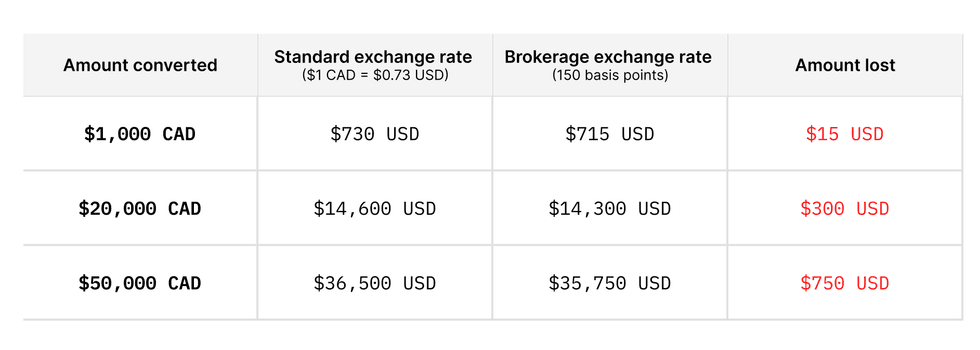
Most of this can be saved by performing the Norbert’s Gambit strategy.
Dual-Currency securities
Some securities trade in multiple currencies. Most of these are Canadian companies that are also listed on a US exchange, which helps them get exposure to American investors. This means the same company will have a stock in CAD on a Canadian exchange and stock in USD on an American exchange, both of which represent the same company.
When a company trades in multiple currencies, its shareholders can exchange their shares in one currency for shares in another, for the same amount of shares on the other side. This is called journaling, and most brokerages provide it for free or at a small cost.
The Norbert’s Gambit process from start to finish
Journaling allows holders of a dual-listed security to swap their shares from one currency to another, without any fees ever applying. That means it’s a potentially lossless (if indirect) way to convert currency.
Say you’d like to exchange CA$ to US$. First, you’d buy shares of a dual-listed security in CA$. Once one is purchased, you will contact your brokerage and ask to journal your shares from the Canadian side to the American one. This may take a couple days, but once it’s done, you will see the new shares in your account. To get your fresh American dollars, you’ll then sell those shares.
Once you do, you’ll have successfully converted your currency, all while avoiding any losses from currency exchange fees.
Are there any risks?
One of the disadvantages of Norbert’s Gambit is that when you purchase stock in any company, you are exposing yourself to market risk. For the time that you have it, that stock could decline in value. This amount could be more than the amount you stand to gain from avoiding the typical exchange rate from your brokerage.
There is, however, a solution to this. Most Norbert’s Gambit enthusiasts will strategically select a dual listed ETF called DLR.TO (which trades in CA$) and DLR.U.TO (which trades in US$). This ETF’s sole purpose is to track the Canadian/US exchange rate. If the exchange rate moves, it will move, but if it stays the same, it will too. These swings tend to be far more minor than those seen in the average public company, making DLR a more reliable stock to use for Norbert’s Gambit.
Summary
Norbert’s Gambit is a strategy that seeks to save money when exchanging CA$ to US$ or vice versa. It is the process of buying a security in one currency, and then journaling it to its dual-currency equivalent in the other currency. The securities most often selected for this strategy are DLR.TO and DLR.U.TO, since these ETFs track the exchange rate and are not exposed to standard market risk. The savings of this strategy scales with how much the investor is looking to exchange, and can be quite significant for large conversions.