

When Abdo Laalami moved from Cannes to Toronto in 2023, he had one goal: buy a place of his own. But at the time, all he could afford was a postage stamp of a studio downtown or a condo in a sleepy suburb, and neither option was all that appealing. So Laalami, a 31-year-old IT specialist, kept his eye on the market and squirrelled away everything he could to save a down payment while he waited.
As the years passed, Laalami was thrilled to see prices on one- and two-bedroom downtown Toronto units begin to fall – the condo bust that everyone was waiting for was finally materializing. By the end of December 2025, Laalami scored a two-bedroom condo in a one-year-old building for $497,000, about 26% off the $699,990 it was originally listed at in May 2024. “It’s definitely a win,” Laalami says of his purchase. “I was able to take advantage of the situation.”
But Laalami’s condo purchase is only a good deal because he's in no rush to sell, and that's the part that the supposed "condo buyers’ market" often leaves out: Condo purchases are usually looked at as a shorter-term prospect for younger people, where they live in it or rent it out for a few years to build equity, then sell it at a profit and upgrade to a house. A 2019 report from Your Neighbourhood Credit Union found that condo owners are more likely to stay in their home for less than five years, while homeowners are more likely to plan on staying for 10 years or more.
For most young buyers, a decade-long commitment isn't part of the plan – Laalami’s an exception. He bought a place that will accommodate changes in his life for the next decade: With two bedrooms, there's plenty of room for a partner to move in, or even to start a family, if that’s where life takes him. “It’s something that is going to fit my needs for the upcoming years,” he says.
His condo purchase mimics the classic “buy and hold” strategy that institutional investors have always relied on. The difference is that massive real estate firms and investors like pension funds can afford to buy hundreds of units at once and wait for the market to recover.
In May of this year, Montreal-based real estate firm Jesta Group spent $30 million on the bulk purchase of existing condos in Toronto, with plans to spend another $500 million to acquire 1,000 additional units over 12 months. In a press release, the company described Toronto's market as “a unique window to deploy capital at scale.” Retail investors – your everyday mom-and-pop buyers who pick up a pre-construction unit or resale condo as a retirement nest egg – just can’t afford to play that game.
Retail investors have come out on top for decades, despite carrying inadvisably imbalanced portfolios focused on real estate, and it’s time that changed.
Thomas Davidoff, an associate professor at UBC’s Sauder School of Business and a director of the UBC Centre for Urban Economics and Real Estate, thinks that it's not necessarily a bad thing to have fewer mom-and-pop buyers and more institutional investors in the market. Retail investors have come out on top for decades, he says, despite carrying inadvisably imbalanced portfolios focused on real estate, and it’s time that changed. “Putting so much of your portfolio, 100% of your net worth, into a single super risky asset – it's the opposite of anybody's portfolio advice, which is that you should diversify,” says Davidoff.
But another entity that can make the buy-and-hold strategy work is the government. In June 2026, Prime Minister Mark Carney announced a plan to buy more than 2,200 vacant condo units in Vancouver and turn them into affordable homes. Some have criticized the move as a developer bailout, but given current market prices, Ottawa stands to acquire those units at a huge discount. Apparently the federal government thinks it's a condo buyers’ market, too.
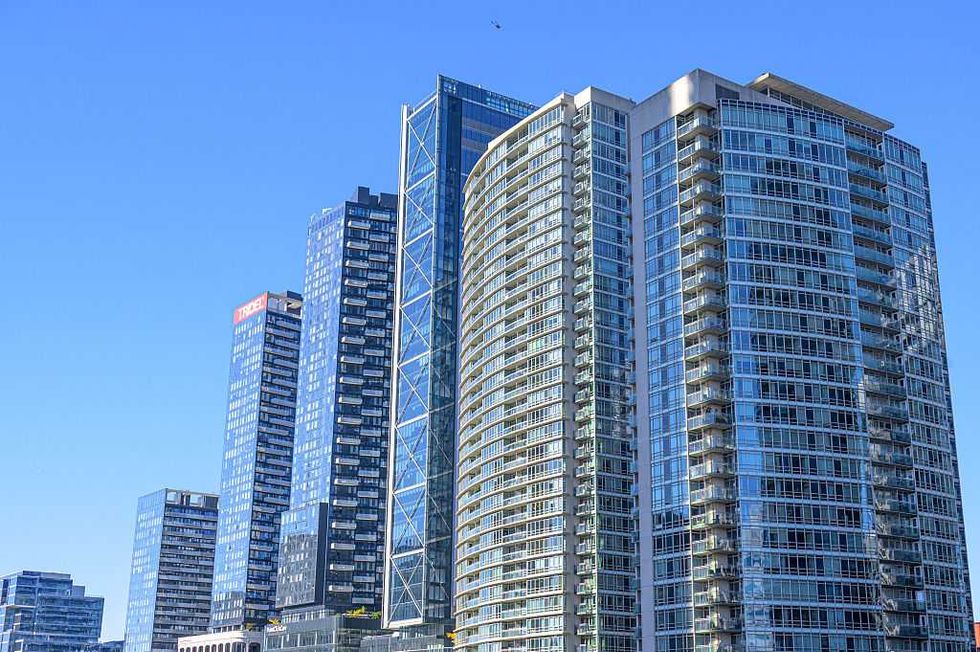
Condo owners are more likely to move after less than five years in the unit.
Getty Images
To be fair, individual buyers can technically take advantage of lower condo prices, too. Toronto realtor Davelle Morrison has seen it with her clients – in June 2025, she helped a former renter secure a one-bedroom downtown Toronto condo, over 500 square feet with a balcony, for just $364,000. It was originally listed at $399,999. “When my clients come to me and tell me their budget is $400,000, in my mind I think I don't know if I'm going to be able to help them,” she says. “I, too, am shocked by what's out there and the fact that I actually have a lot to show them.” But in the current market, a good deal doesn't guarantee a quick profit.
“The risk of a continued decline is high,” says Davidoff. “Nobody wants to catch a falling knife.” Purchasing pre-construction units used to be a sure bet for mom-and-pop investors, whether they sold after completion or rented it out afterwards. In the first quarter of 2026, 246 new condominiums were sold in the Greater Toronto Hamilton Area, a 52% decline from the previous year. For the first time in at least 30 years, there were no new project launches during that quarter.
“The risk of a continued decline is high. Nobody wants to catch a falling knife.”
The market always recovers – heck, even Detroit’s real estate market has doubled in the past decade. Jay Charbonneau, real estate partner at EY Parthenon, sees a turning point coming around 2029, when the supply from today's stalled pre-construction market will start to thin out. Newly built condos will continue reaching completion in 2027 and 2028, but after that, the pipeline dries up – it takes three to five years to build a new condo, and almost nothing new is being started today. And there are plenty of levers for Ottawa to pull if it really wants to increase demand again. “You start to layer in things like: will the federal government look at increasing immigration numbers or remove caps on international students – the things that have been tamping down demand a little bit,” Charbonneau explains. “You could see all those things come together, where, in 2029, suddenly the demand is still there and yet nothing new is coming on stream.”
There are other condo markets worth considering: Cities like Winnipeg and Montreal, where the condo market has historically attracted fewer investors, have stayed more stable, and Charbonneau says Edmonton and Ottawa could work for buyers willing to sit on their hands for a while.“If you're not looking for a quick windfall, those markets are probably better suited to the longer-term, more pragmatic investor,” he says.
So, what are your options if you want to win in the current condo market? Aside from buying hundreds of units at once or holding long-term like Laalami, they're pretty limited. You can buy and deal with a loss if you need to sell short-term, set aside your home ownership dreams and keep renting, or look to more stable markets elsewhere in the country. These options are actually kinda grim! But underneath those low, low prices, the condo buyer's market right now just isn't the sure bet that it seems – unless you can afford to act like a pension fund.