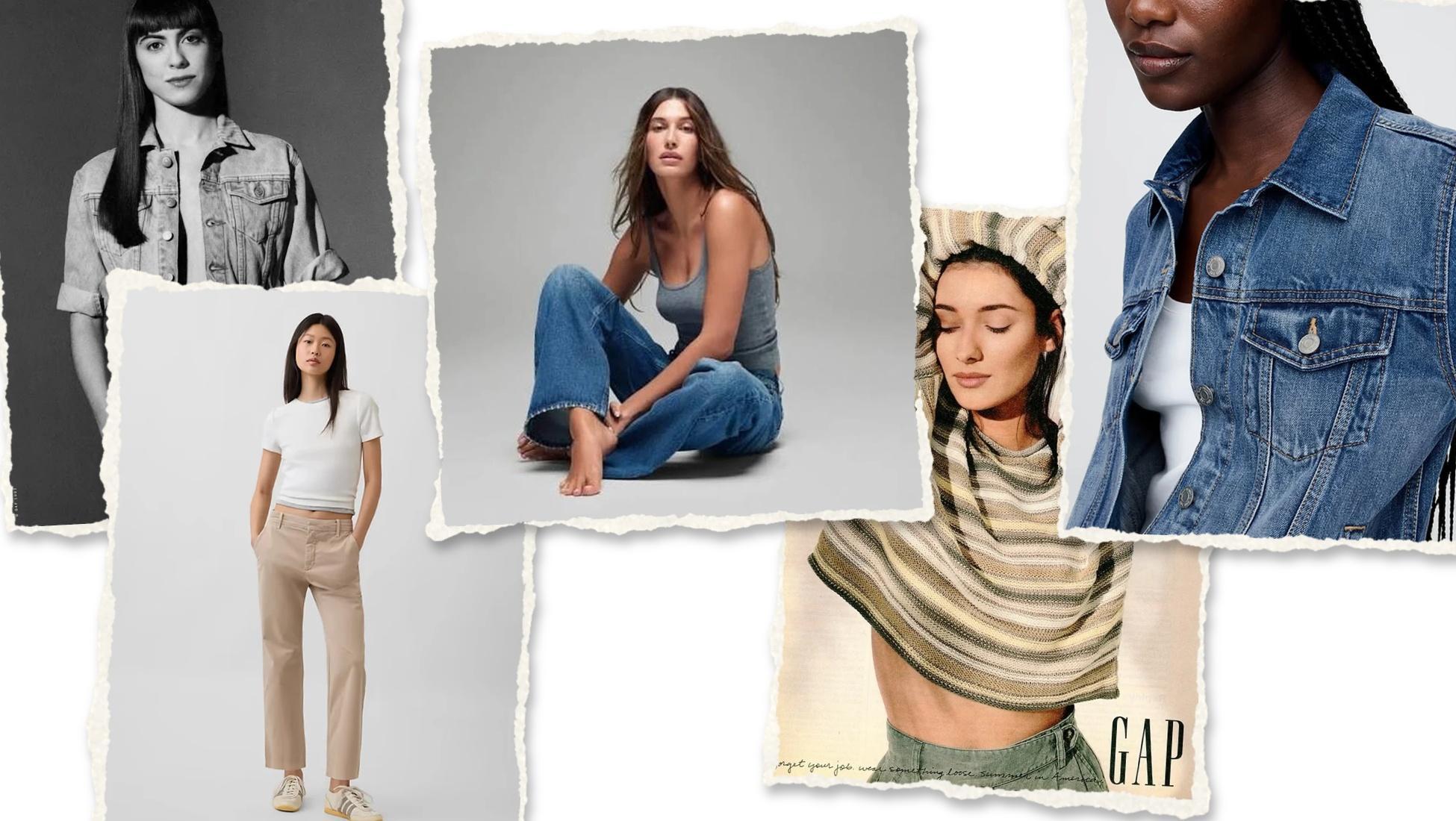
When Gap rolled out this year’s autumn campaign, millennials everywhere rejoiced. Urging consumers to “press play like it’s 1996,” the brand used a simple CD player to lay the groundwork for a mid-'90s revival, beginning with its launch of The Hailey Jean, continued with the resurrection of Gap Scents, and continued with a choreographed commercial that's essentially the spiritual successor to “Everybody In Vests.”
For those who grew up in Gap’s '90s heyday, the marketing behind this new campaign has been a balm to the soul. Yes, "everything was better in the '90s" is mostly a millennial perspective (and likely a predominantly white millennial one), but in using potent nostalgia, Gap has returned a sense of whimsy to back-to-school shopping, luring in shoppers with the ease and comfort of easy-to-wear wardrobe staples that defined teen and 'tween closets 30 years ago.
But a '90s aesthetic doesn't mean '90s prices (if only). Thus, for research purposes, we're setting nostalgia aside in favour of cold, hard facts. Are Gap prices in 2026 really on par with its 1996 version? Even if the styles are similar, is it as affordable now as it was (or wasn’t) three decades ago? And if we’re really so enamoured with the mid-'90s, are we truly prepared to see everybody in vests? Let’s proceed.
CATEGORY: Jeans
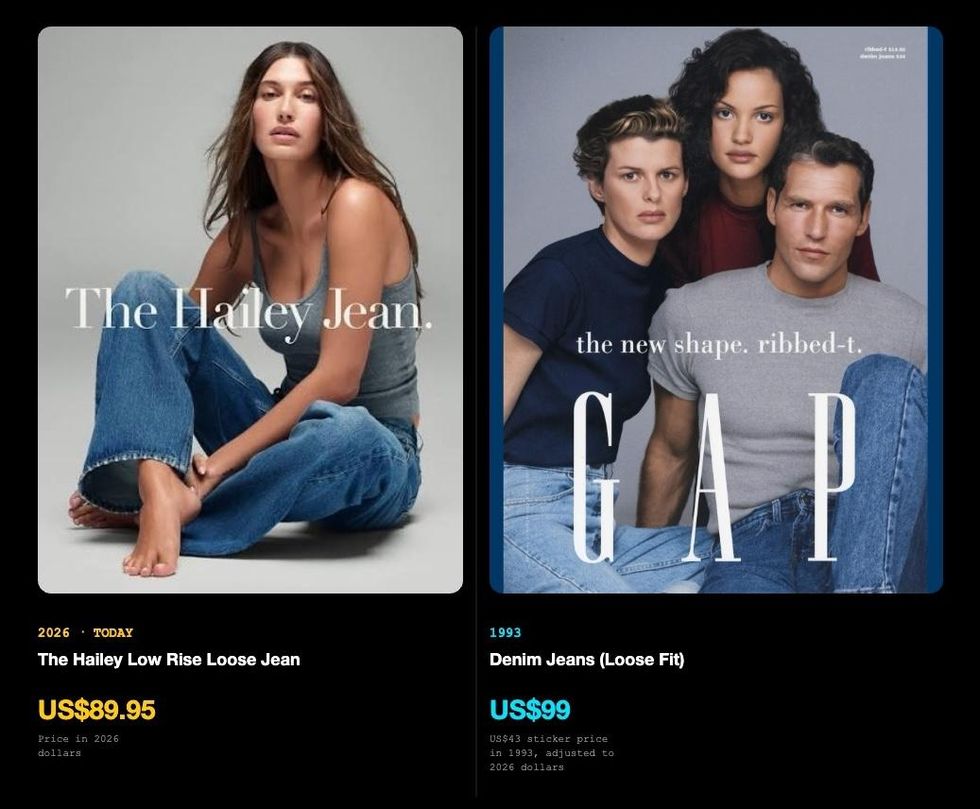
Gap's 2026 Hailey Jean and the 1993 denim jeans.
GAP / @gapplaylists/Instagram
The modern piece: The Hailey Low Rise Loose Jean, US$89.95
Snug at the hips, loose in the legs, and cut low enough to avoid being mistaken for a pair of Mom jeans. Ideally paired with a baby tee, a large flannel, and combat boots so as to evoke the spirit of Gia, Stephanie Tanner’s no-nonsense best friend on Full House.
The '90s counterpart: The Loose Fit. In 1993, an average price for basic 'denim jeans' was advertised for $43, but a 1995 price guide lists the Loose Fit as ranging between US$34 and US$48.
Inflation-adjusted '90s price: Using an average of US$43 for the Loose Fit, it equates to about US$98 in 2026.
The difference: Today, you’ll actually spend US$8.05 less than you would in the '90s.
The verdict: This is one of the few points in history when travelling back in time would set you back financially. If you buy one pair of the Hailey jeans, you’re paying about 8.2% less than you would've paid when the original Jurassic Park was released.
CATEGORY: Button-up shirt
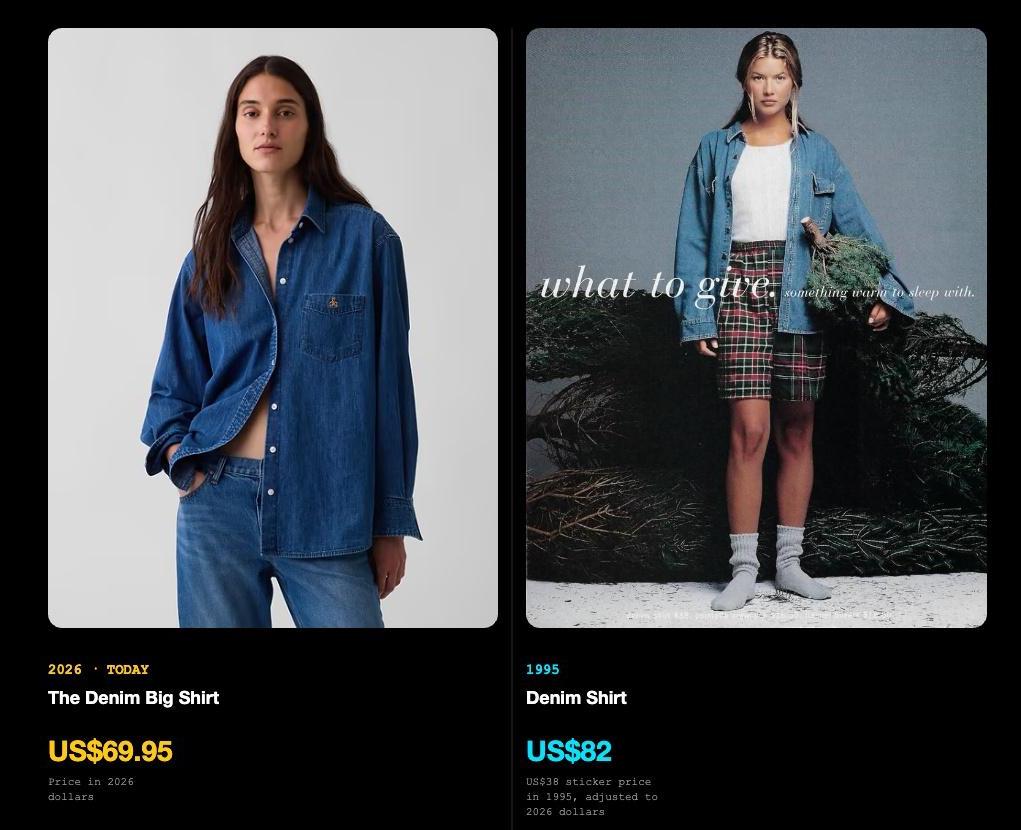
Gap's 2026 denim shirt and the 1995 counterpart.
GAP / @gapplaylists/Instagram
The modern piece: The Denim Big Shirt, US$69.95
The Big Shirt walks the fine line between early-'90s grunge (if you size up) and business casual (if you size down). Tie it around your waist for even more '90s cred, or wear it buttoned all the way up, like Steve Zahn in Reality Bites.
The '90s counterpart: The corduroy shirt (US$42), the flannel shirt (US$42), or the denim shirt (US$38). Featured as part of Gap’s 1995 holiday campaign, these were easy gift options, since they could be worn casually, very casually, or Canadian casually (i.e. tucked-in flannel, paired with a belt).
Inflation-adjusted then-price: A US$38 denim button-up in 1995 would cost about US$82 today.
The difference: Perhaps shockingly, Gap continues to be more affordable today. Adjusted for inflation, a Big Shirt costs US$12.05 or 14.7% less in 2026 than it did in 1995.
The verdict: I'm sending everybody on my shopping list a Gap button-up for the holidays. With the money I save, I’ll assemble one giant, Big Shirt-based wardrobe to rule them all.
CATEGORY: Sweater
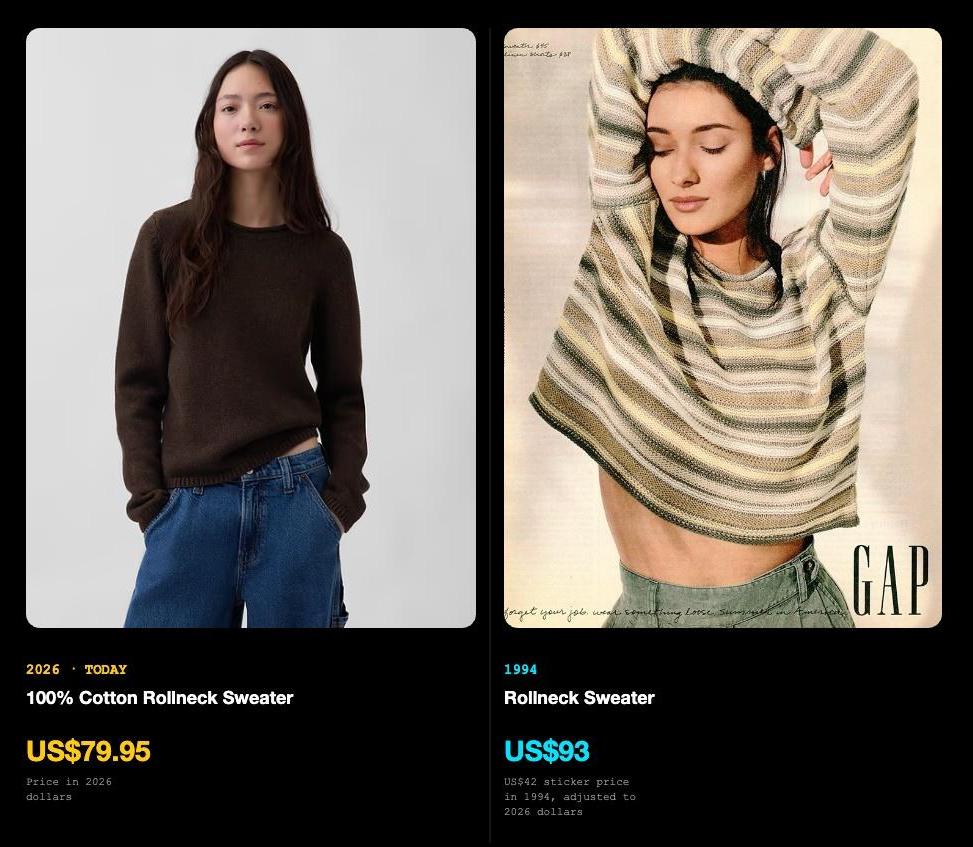
Gap's 2026 rollneck sweater and its 1994 version.
GAP / @gapplaylists/Instagram
The modern piece: 100% Cotton Rollneck Sweater, US$79.95
A departure from the oversized uniform of the mid-1990s, this rollneck captures the casual, coastal aesthetic of a Nancy Meyers character with an obscenely large kitchen. Think: Diane Keaton sitting seaside at a Martha Stewart dinner party, sipping chardonnay.
The '90s counterpart: (Rollneck) Sweater. Priced at US$42 in 1994, the Demarchelier-shot campaign urges potential wearers to “forget [your] job” and “wear something loose.”
Inflation-adjusted price: Roughly US$93. So, actually, don't forget your job if you want to buy this.
The difference: Once again, Gap corners the market on aspirational over practical. While urging its consumer base to lose themselves in an abundance of fabric, customers in 2026 are actually paying US$13.05 or 14% less for a comparable sweater now.
The verdict: Regardless of how baggy you like to wear your clothes, in this economy, you should hold onto any and all forms of employment. A loose-fitting sweater can adapt to almost any office setting.
CATEGORY: T-shirt
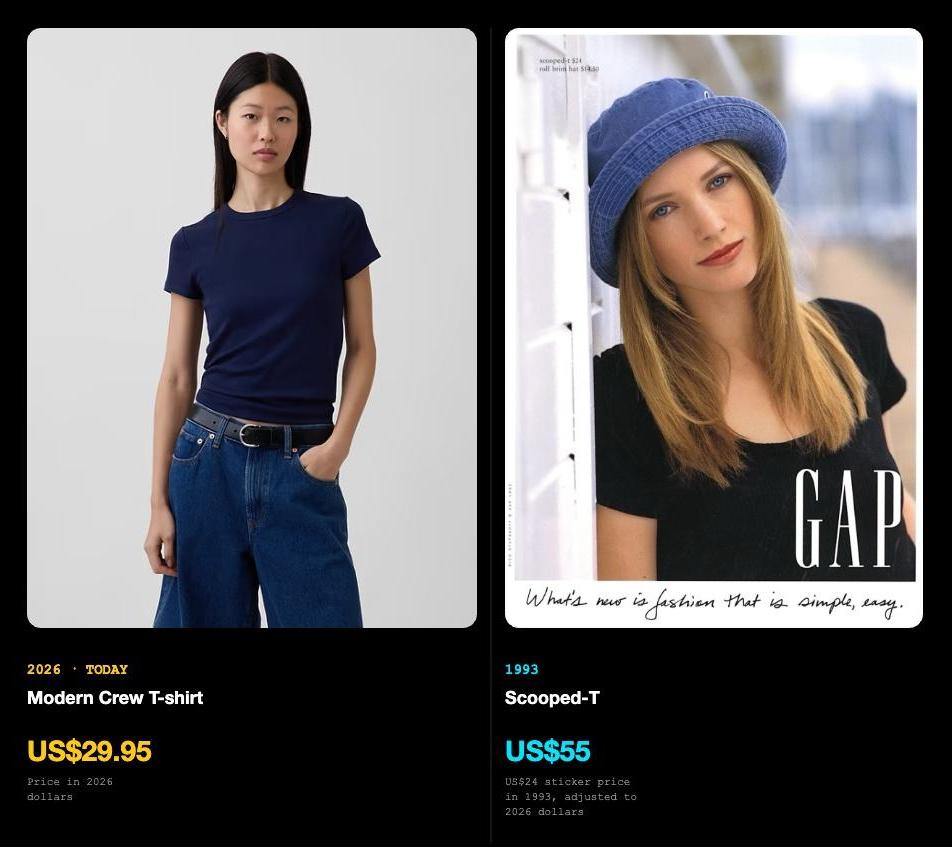
Gap's 2026 T-shirt and the 1993 version.
GAP / @gapplaylists/Instagram
The modern piece: The Modern Crew T-Shirt, US$29.95
Considering Gap’s '90s domination was built atop affordable, everyday pieces, no retrospective would be complete without its multipurpose cornerstone. Plain T-shirts are timeless regardless of brand, so a lower price point makes sense, since you can pick up a pack of Fruit of the Loom tees for less.
The '90s counterpart: The Scooped-T. At a relatively reasonable US$24, this summer 1993 scoopneck does exactly what it’s supposed to do: help make the corresponding bucket hat shine.
Inflation-adjusted price: Despite then-creative director Mickey Drexler’s emphasis on “affordable” day-to-day pieces, this particular T-shirt would cost around US$55 today.
The difference: With a whopping 45% difference, you can almost buy two Modern Crew T-Shirts in 2026 for the price of one from 1993.
CATEGORY: Denim jacket
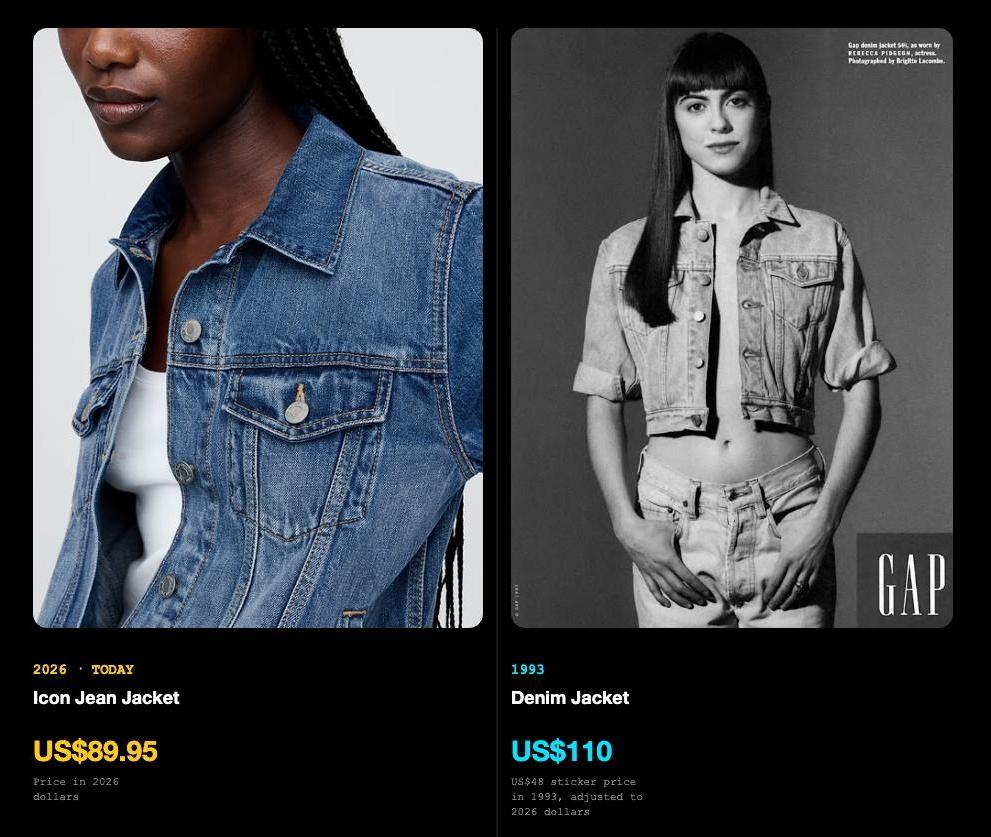
Gap's 2026 jean jacket and the one it sold in 1993.
GAP / @gapplaylists/Instagram
The modern piece: The Icon Jean Jacket, US$89.95
To have lived through the '90s without once wearing a denim jacket is practically a mathematical impossibility. Whether as part of a suburban uniform, a way to jazz up an airport ensemble, or a means of asserting one’s profound understanding of the 90210 aesthetic, the denim jacket managed to – and still does – work with everything. Once you acquired your own, you no longer had to fight with your mom about taking a coat along to wherever you were going.
The '90s counterpart: The Gap Denim Jacket. Priced at US$48 and featured in a 1993 ad by Brigitte Lacombe, this version of our t(w)een staple offered a more grown-up approach to denim. While many of us reserved our jean jackets for standing around at recess and/or hoping our crushes would be awed by how we coordinated outerwear with our overalls, this Gap campaign appealed to an audience willing to shirk traditional dress codes.
Inflation-adjusted price: For about US$110, which is what the 1993 shirt would cost today, you too can wear a fitted denim jacket like an unbuttoned shirt.
The verdict: Here in 2026, you can pair a brand-new jacket with a crewneck T-shirt for about the same price as a single coat in 1993. And if you’re feeling brave: try wearing both with overalls.
CATEGORY: Khakis
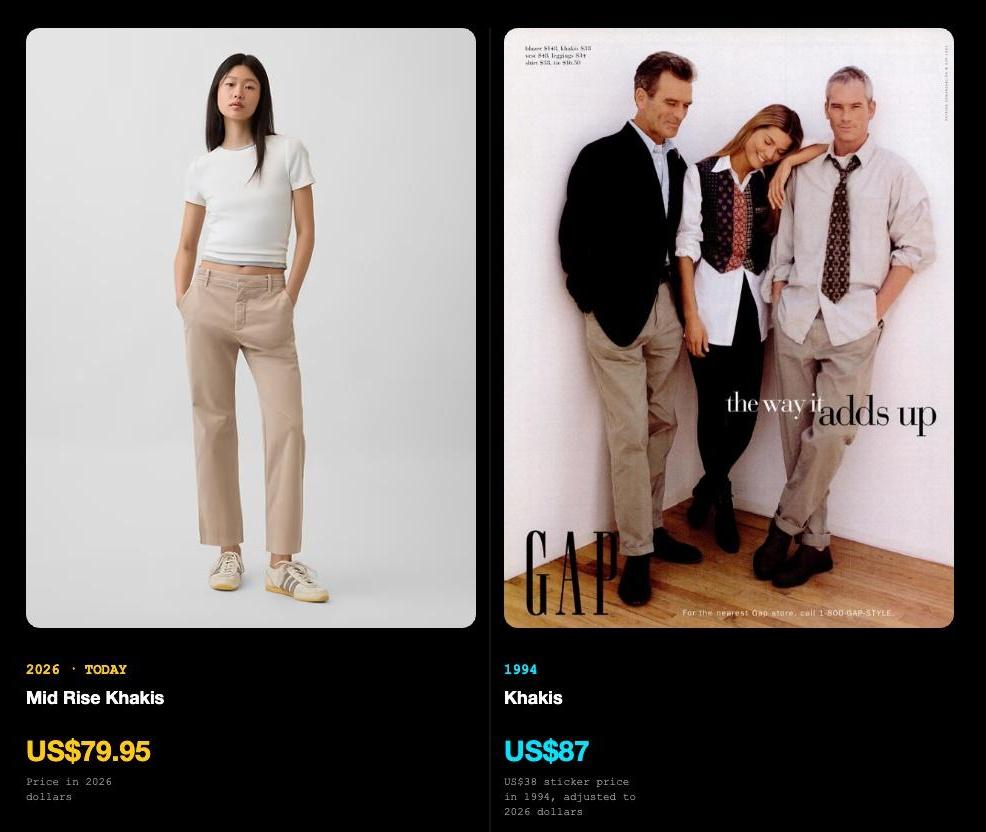
The khakis Gap sells in 2026 and the 1994 version.
GAP / @gapplaylists/Instagram
The modern piece: Mid Rise Khakis, US$79.95
Is business casual even attainable without khakis? Is it even possible to jump, jive, and wail? Without khakis, how can you possibly channel Chet Baker, Andy Warhol, Amelia Earhart, or James Dean? While Gap Jeans may sit centre stage this particular autumn, Gap's empire was based on the middle ground between dress trousers and casual pants. To reject khakis is to reject peak Gap entirely.
The '90s counterpart: Khakis. For US$38, you too could say “These are dress pants, mom!” when asked if that was really what you were wearing to your aunt’s bridal shower. Speaking of matrimony, these khakis were promoted as marrying business and casual, making them a crucial component of the Gen X yuppie wardrobe.
Inflation-adjusted price: At about US$87, you’re still saving more than $7 if you invest in 2026 khakis over their 1993 predecessors.
The verdict: I'll jump and jive to the fitting room to try them on, before wailing that I simply do not look good in khakis, no matter the price.
The bottom line
Nostalgia claims that the '90s were simpler, cheaper, better, but looking at the facts and figures, maybe Gap in 2026 has it backwards – Gap was actually more expensive in the mid-'90s than it is now.1 Now, does this mean that life really is better in 2026 than it was when we were young? HAAAAAA of course not. Have you looked at a newspaper recently?
Gap’s lower prices are likely not the result of a shift in industry values; the brand's use of sweat shop labor has long been documented, and in 2007, the brand came under fire for having children working at their factories in New Delhi. Even now, despite Gap's push to maintain an ethical supply chain, watchdogs Good On You still only rate the company at “It’s a Start.” This means that its affordable price tags are the result of competing with fast fashion brands like H&M, Zara, and Shein, which can mean lesser-quality fabrics and exploited labour, since brands are forced to produce items so quickly.