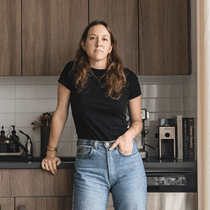
Free Label, a Vancouver-based ethical fashion brand, charges nearly $100 for a T-shirt, and nearly $170 for a pair of shorts. At those prices, you’d likely assume the company turns quite a healthy profit, but that isn’t the case – on a single shirt, for example, the label actually nets nothing.
Ethical fashion brands, also called slow fashion brands, adhere to an array of values, including ethical production (paying craftspeople a fair wage at every stage of the supply chain), sustainable production (using eco-friendly fabrics and making pieces in small batches to minimize waste), and inclusive sizing (offering more than just extra-small to extra-large in order to better serve a range of bodies). These values come at a cost, as Free Label founder Jess Sternberg knows well. Here’s how she makes it work.
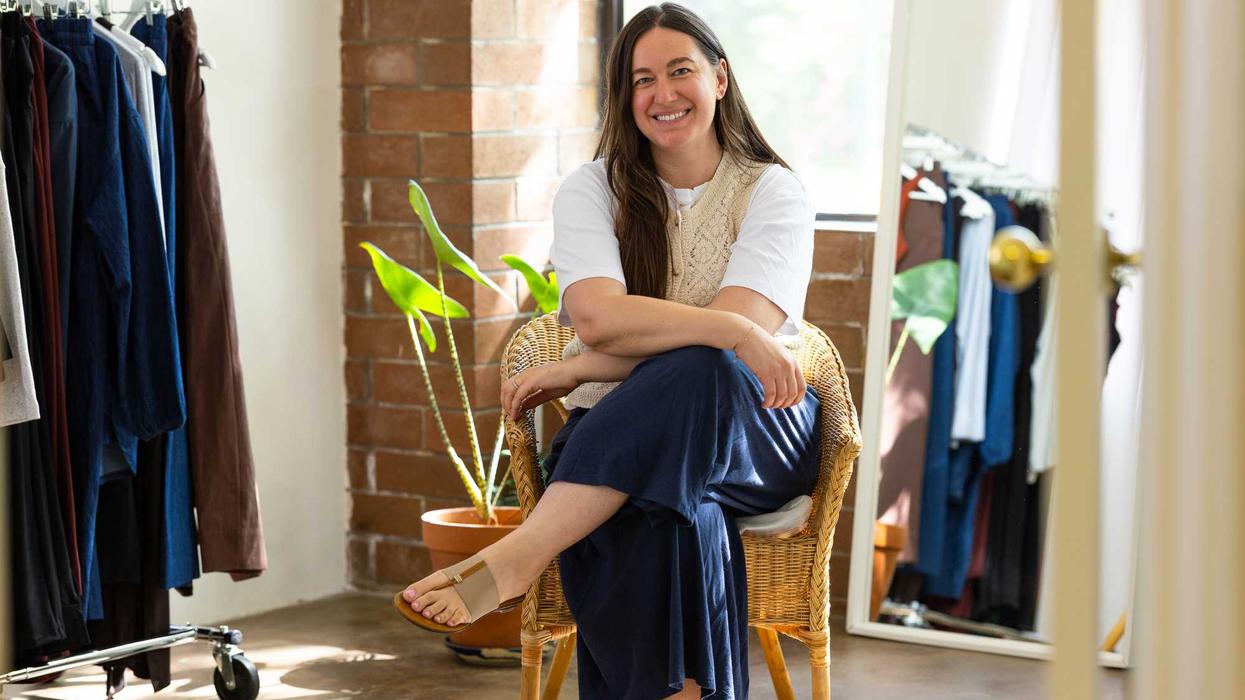
Meet Jess Sternberg, founder of Free Label
Sternberg, who now produces her clothing in Vancouver, started Free Label in 2015 in Toronto. “Nobody was making things in Canada,” she says of the time period. “And I found especially, there weren’t a lot of people making anything that was geared towards my body shape, which is a little bit more curvy, and in a way that really celebrates and honours the female body. I thought I could fill that gap.”
She had no entrepreneurship or design experience, instead learning as she went, working with Canadian textile manufacturers, pattern-makers, and sewing factories to produce an array of clothing, available in sizes XS to 5X, that fits all kinds of shapes, including bras that go up to cup size K.
By comparison, fast fashion is typically made overseas, where production costs are much cheaper and workers are paid incredibly low wages to sew poorly-made items in unsafe conditions. Because the fast fashion business model is about volume rather than quality, it’s also bad for the environment: the fashion industry is the second-biggest consumer of water, and fast fashion in particular leads to increased carbon emissions, the production of non-biodegradable microplastics, and toxic chemical run-off in waterways, particularly in countries like Bangladesh, where these clothes are often made.
How the money comes in
When Free Label first launched, Sternberg earned money by selling directly to customers as well as wholesaling to boutiques, the latter of which meant selling her pieces at a discount so the stores could mark them up and turn their own profit. But this wholesale model required her to take 50% less per item than she would by selling directly, so in 2019 Sternberg switched to a direct-to-consumer strategy. Now Free Label is available exclusively via its ecommerce store.
What it actually costs
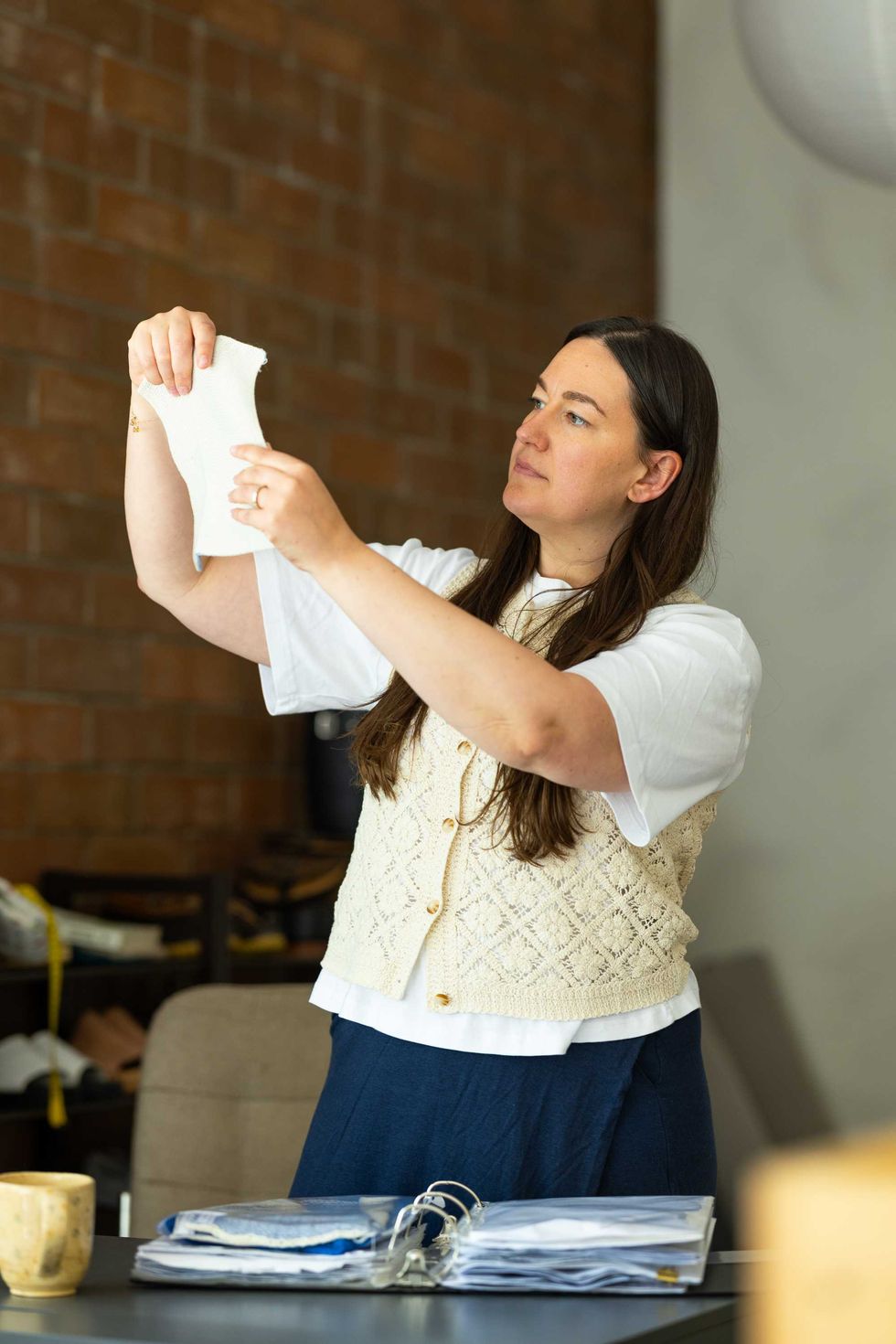
Sternberg examines fabric samples. Production costs alone account for $25 of every $98 shirt Free Label sells.
Mark Yuen Visuals
Sternberg walks through the math on a $100 T-shirt (Free Label’s shirts sell for $98, but we’ll round up for simplicity). The production costs for one shirt – including fabric production, sewing, and pressing – are about $25. On average, it’s another $25 to ship that item to a customer. Approximately another $50 for operational costs, including staff, marketing, warehousing, and other expenses such as Shopify and PayPal fees. That means if Free Label is selling a shirt for $98, it’s not making any profit on it.
“I would say probably 70% of the people I talk to in slow fashion are in debt,” Sternberg says. “Profitability, especially for slow fashion brands, is so important, because the margins are so, so thin.”
Free Label gets to profitability in a different way: the average order includes more than one item, which means that the brand is essentially saving that $25-per-item shipping fee. Sternberg also cuts down on big expenses like product development (which can cost thousands of dollars for just one new style, because every sample has to be made individually and can cost upwards of $200 apiece) by reintroducing well-performing designs in revamped colours.
“We do really well with our bras, and we bring them back every year,” she says. “We try not to make more than one new bra style a year, because it really takes away from profitability.”
In addition, Free Label’s low return rate helps the brand stay afloat. Whereas ecommerce’s average return rate is between 15 and 20%, Free Label’s hovers around five. “If we had higher returns,” Sternberg says, “I don’t think we would survive.”
What's left over
According to Sternberg, Free Label has an annual pre-tax gross profit margin of about 17%. While that number varies from year to year, in 2022 (the brand’s best year so far) it earned $1.7 million in revenue and its profit was less than $300,000 (before tax), most of which gets reinvested back into the company.
In the brand’s first two years Sternberg paid herself nothing. Once things were off the ground, she paid herself in dividends; it was only within the last few years that she started putting herself on payroll, earning low to mid six figures.
The Canadian context
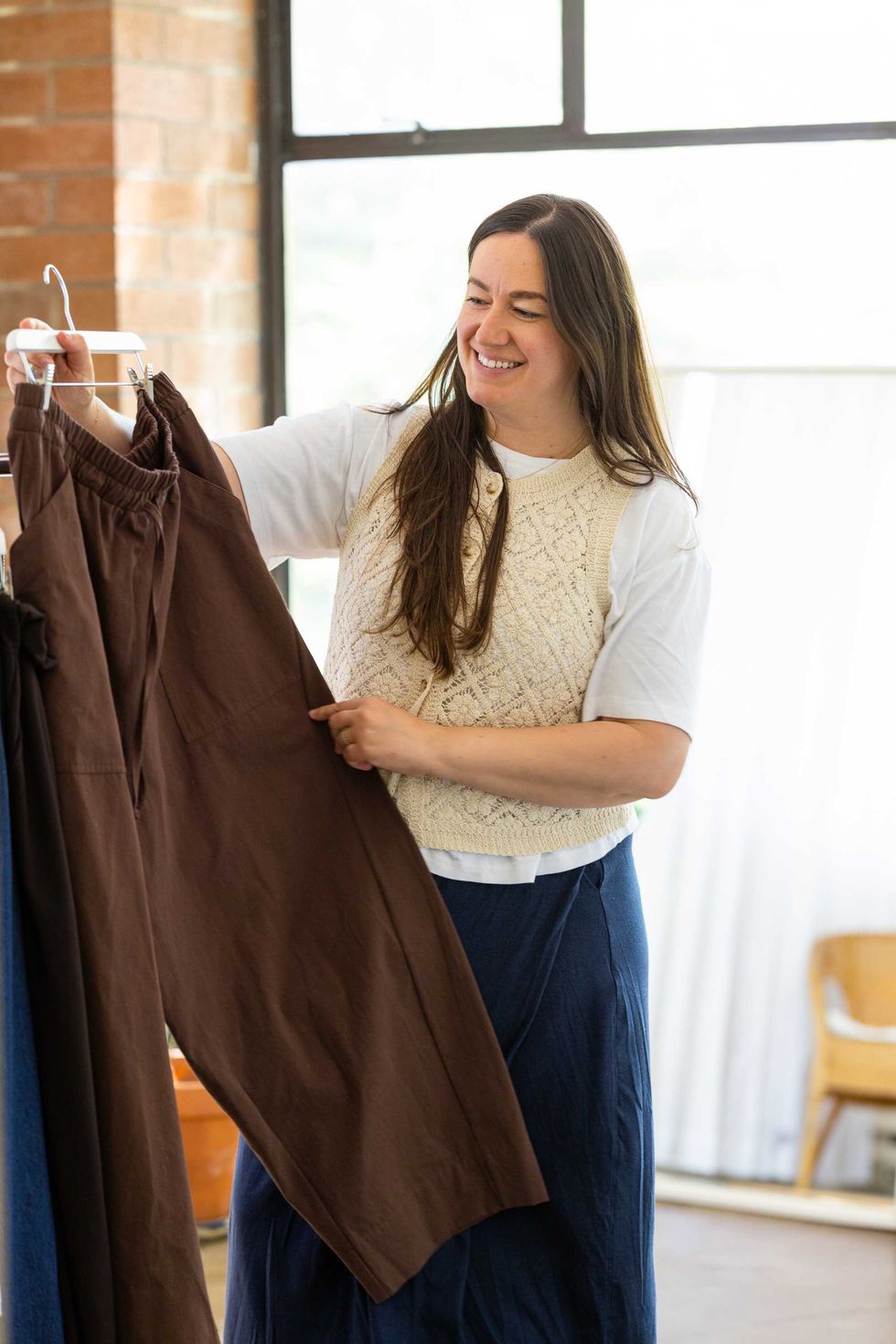
Free Label's clothing is made in small batches in Vancouver, which keeps waste down and costs up.
Mark Yuen Visuals
While there are some tax breaks available to companies that make their goods in Canada, Sternberg says that Canadian-made clothing is not eligible – and thinks the government should change that. “There’s literally zero incentive to be a Canadian-made [fashion] company,” she says, “which is why nobody does it.”
The tensions between Canada and the US have made things even harder. CUSMA – which replaced NAFTA in 2020, and which historically allowed Canadian-made goods to travel to the U.S. and Mexico duty-free – has a “yarn-forward” rule stating that clothing, in order to qualify for the program, must be made using yarn of CUSMA-country origin. So while Free Label knits its own fabrics in Canada, the yarn itself is imported from outside the CUSMA boundaries, deeming the entire brand ineligible and making it significantly less profitable to ship to the US and Mexico.
“We have the same playing field as imported clothing,” says Sternberg, “with the exception that our clothes are far more expensive to manufacture.”
On top of that, last summer the US government cancelled the de minimis exemption, which allowed shipments under $800 USD to enter the States duty-free, even if they weren’t part of CUSMA. That was a big blow for Free Label, whose customer base at the time was 35% to 45% American. Sternberg decided to halt US shipping as a result, and says that revenue dipped but not dramatically – although the brand’s annual year-end archive sale, which makes up a large portion of its revenue, may reveal a larger decrease.
What most people get wrong
“People say, ‘Oh, that’s overpriced; I would never spend that amount of money on a piece of clothing,’” says Sternberg. “We’ve all been conditioned by fast fashion and the last two or three decades of consumption and production to expect the things we consume to be really cheap.”
She thinks this is largely because it’s primarily women who are making the clothes, and because as a society we undervalue tasks perceived as “women’s work.” It’s also a cost-of-labour issue. Whereas in developing countries like Bangladesh people are being paid less than $3 a day to sew clothing, in Canada, craftspeople are paid a living wage.
“There’s this diminishment of value, and of what it takes to make clothing – even though it’s manual labour,” Sternberg says. “People are not quite making the connection that they want to be paid well for the work they do, and that there’s a high cost of living in Canada – and that when clothing is actually made here, that is reflected in the price.”
The bottom line

The sticker shock you might feel is understandable, but so is charging what it costs to do things right.
Mark Yuen Visuals
On average, fast fashion items are worn less than 10 times before they fall apart, meaning the money spent on them, however little, ends up in a landfill almost immediately. Buying slow fashion means less strain on the environment, both in terms of the actual clothing production and the resulting items ending up in the landfill so quickly.
Ethical fashion does cost more upfront, but that's by design: the price reflects what it actually costs to pay workers fairly, source responsible materials, and make something built to last more than one season. The sticker shock you might feel is understandable, but so is charging what it costs to do things right. Slow fashion isn't accessible to everyone, and even people who can afford it can't always justify the cost. But for those who can, the argument isn't really about getting more for your money – it's about buying less, keeping it longer, and opting out of a system that makes cheap clothes by making someone else pay the difference.