

There’s a typical roadmap to investing that Gen Z seems to ignore. We saw our parents and grandparents follow it to the letter: first a career, then savings, and finally, a serious conversation with a financial advisor. Investing was something for adults, as serious as buying a house. But times have changed. Instead of waiting for a stable career or a professional’s approval, young Canadians are entering the market earlier than any other generation – and often before they’ve even left their teen years. The numbers are clear: Gen Z is changing the market in new ways, and it’s time to pay attention.
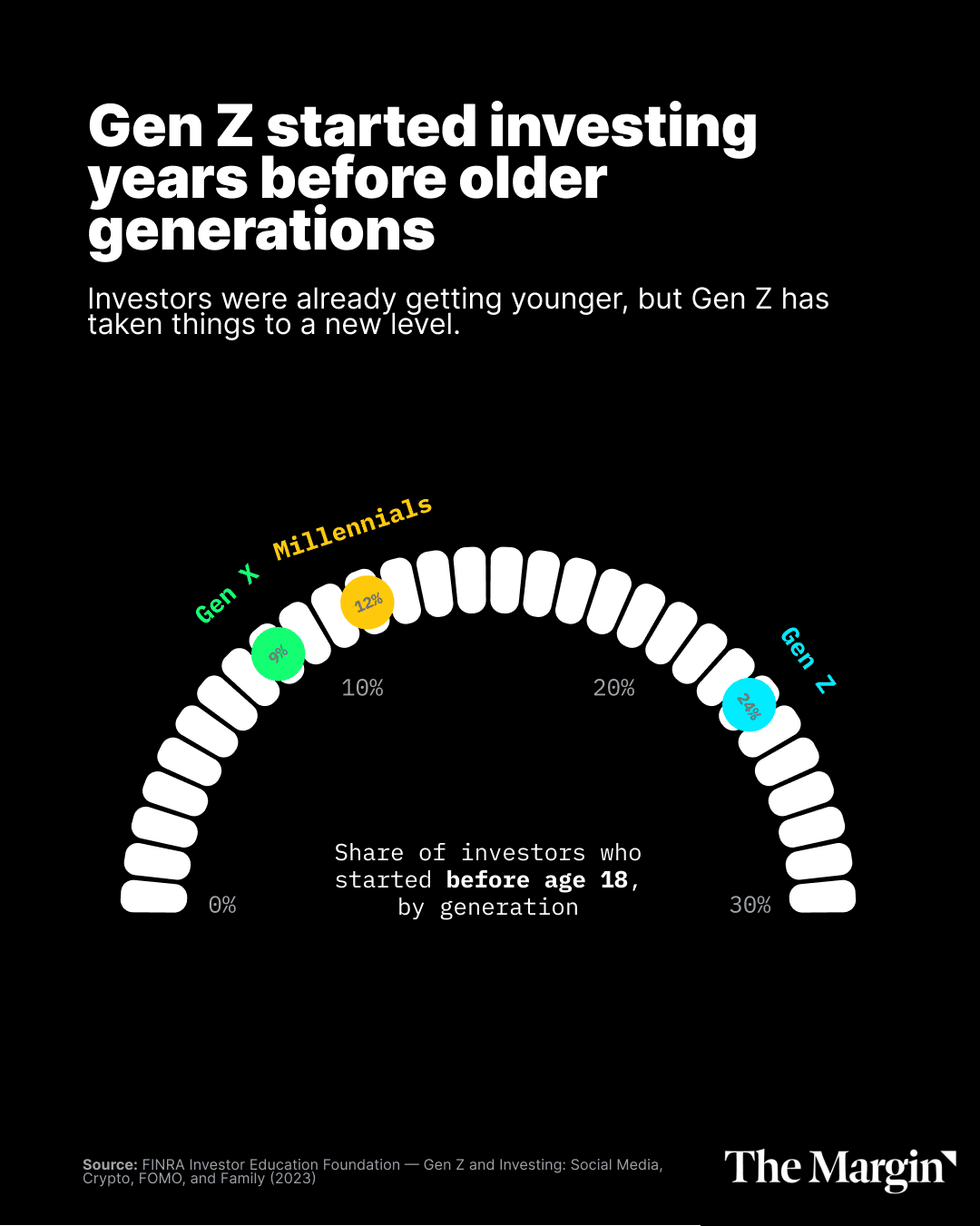
Canadian Gen Z's are investing younger than any generation before them.
Data from FINRA / Chart by Isabella Moura
To get a sense of the seismic shift Gen Z is bringing to the stock market, look no further than the age at which they start investing. A 2023 report by FINRA shows a staggering one in four Gen Zs made their first investment before they even turned 18. That represents a massive acceleration of a trend that was only just getting started with the generations that came before them: under 10% of Gen X’ers made their first investment in their teens, which grew to 12% among Millennials. Gen Zs doubled that number in just one generation.
What happened? The data suggests that while Gen Zs were first drawn to the market by curiosity, it was a digital ecosystem designed with them in mind that welcomed them in. Investment apps themselves lowered the barrier of entry for young people, allowing users to start with just small amounts and, in some cases, no associated fees. No paperwork to fill out, no appointments to schedule, and no advisors overseeing what, for many, is their first transaction.
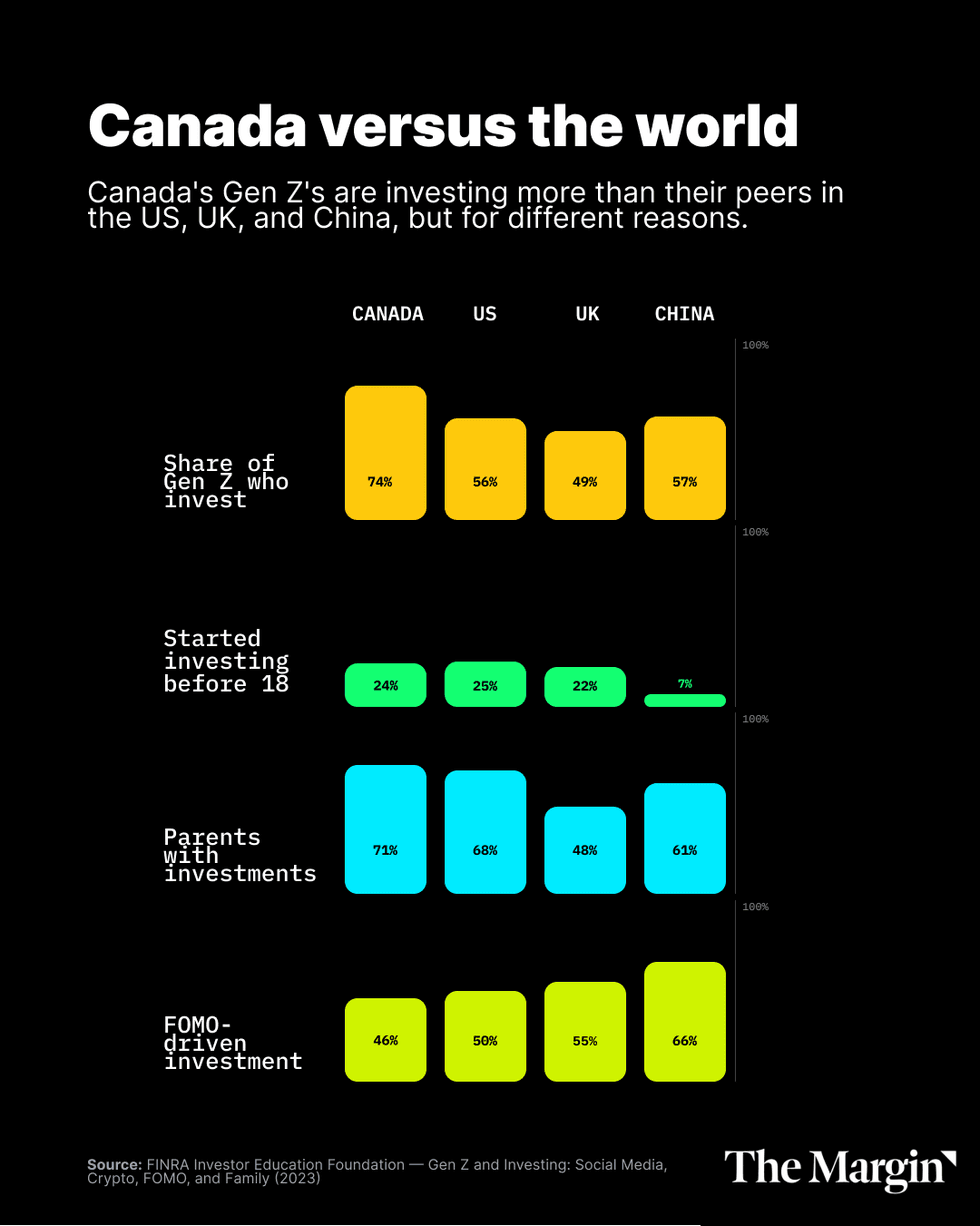
More Gen Zs invest in Canada than in the US, UK or China.
Data from FINRA / Chart by Isabella Moura
Now that they’re in the market, Canadian Gen Zs are leading the charge. With nearly three-quarters of the generation holding at least one investment, young Canadians are comfortably ahead of their peers in China, the US, and the UK. FINRA’s data gives some clues as to why this might be the case. For one thing, Gen Z’s investment habits appear to be correlated with their parents having their own investments, and Canada leads among the four countries in that respect. However, the opposite is true when it comes to what FINRA calls FOMO investing: money put down out of a fear of missing out on big gains. Under half of Canadian Gen Z investors report being driven by this, whereas half or more of their peers in the UK, China, and the US feel it acutely.
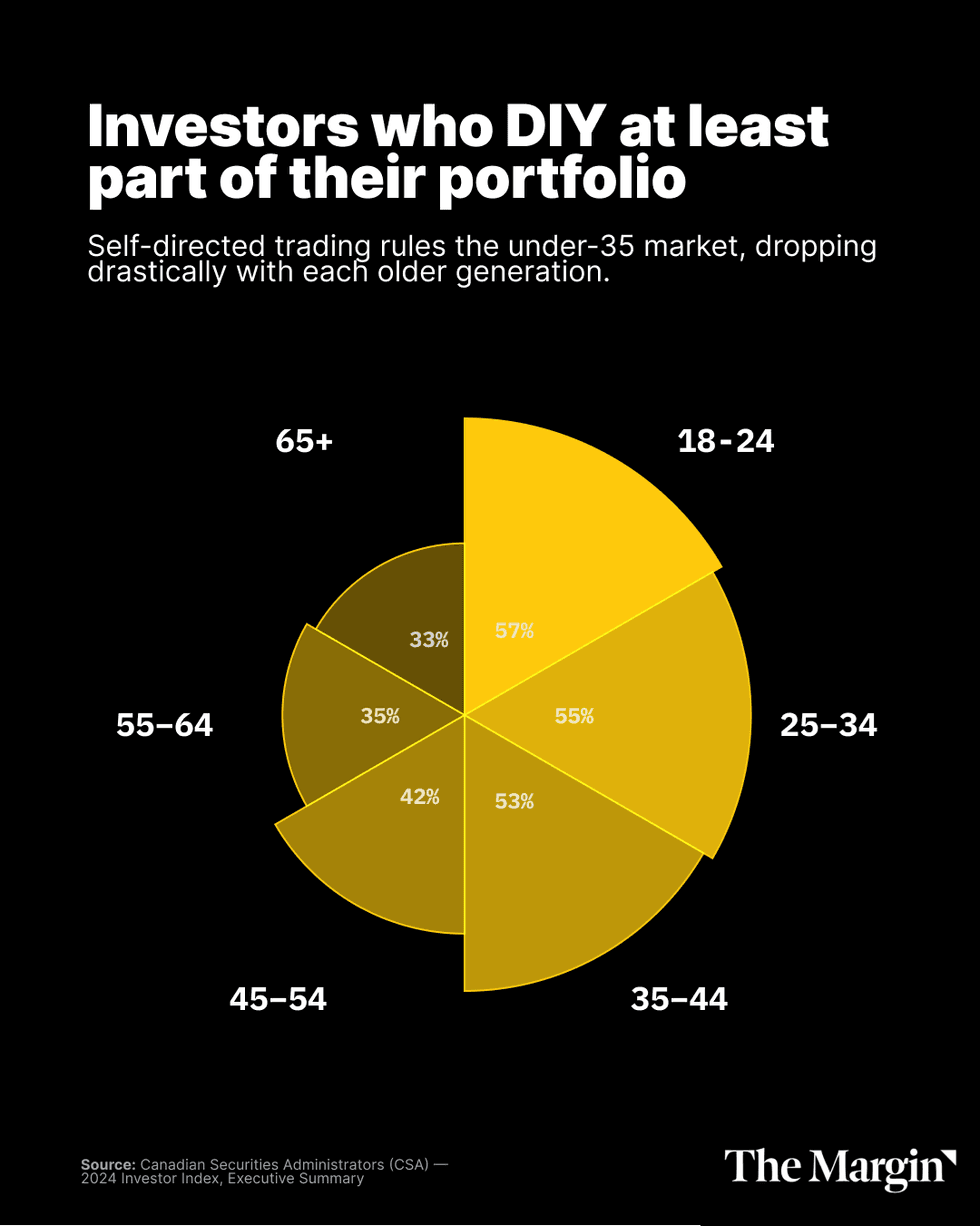
Gen Zs are more likely to manage their own investments than any other generation.
Data from CSA / Chart by Isabella Moura
Gen Z is walking into a market where DIY investing is already the norm. More than half of Canadians aged 18 to 44 have their own self-directed investments in the market. Financial advisors, meanwhile, are falling out of style: between 2020 and 2024, the number of people who met with one declined across virtually all age groups. When Gen Z thinks about investing, therefore, it’s perfectly natural for them to take matters into their own hands.
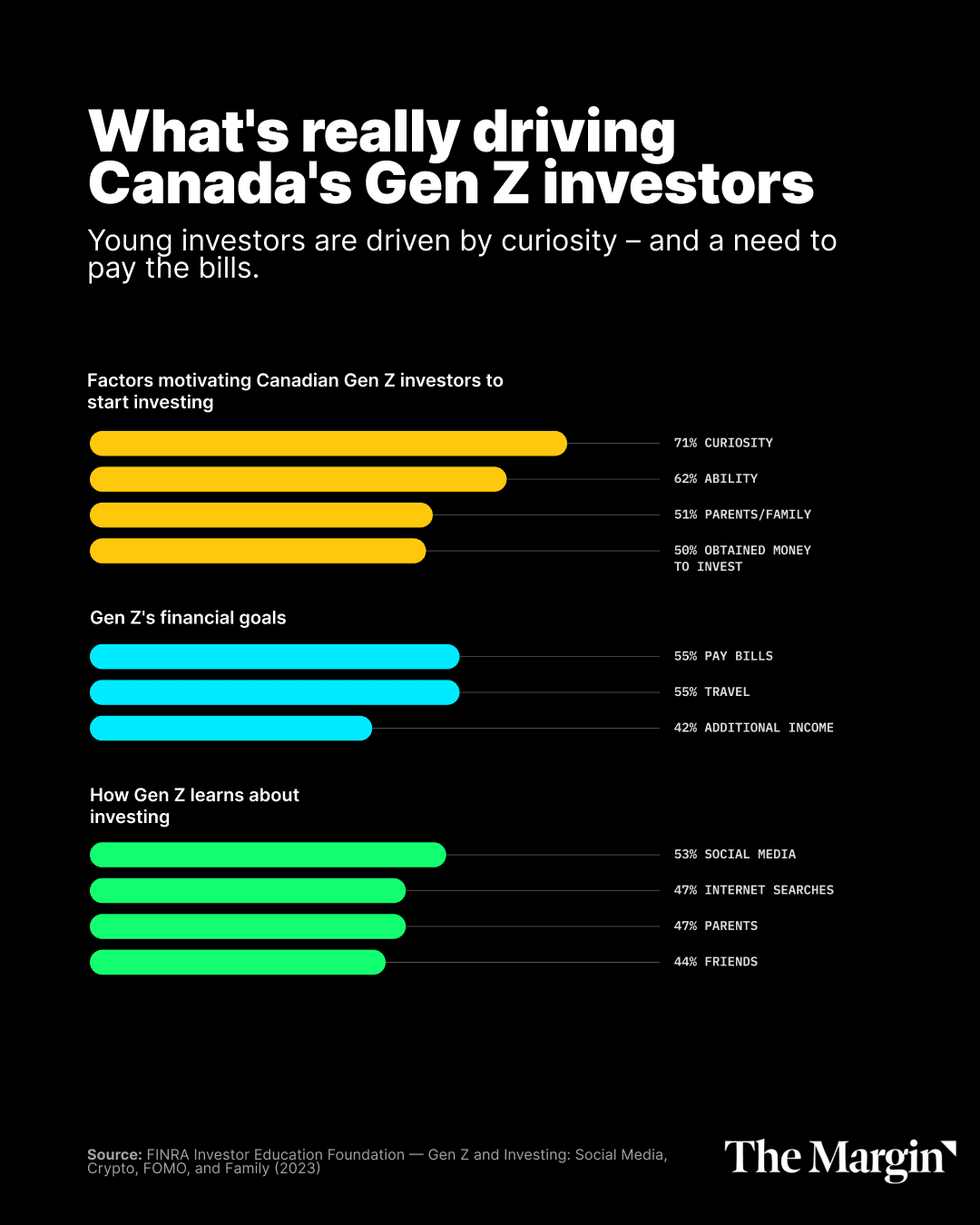
Canadian Gen Zs are driven to invest by curiosity, but also to pay the bills.
Data from FINRA / Chart by Isabella Moura
Having access to an investing app is only half the battle: an investor has to know what to do with their money once they get there. FINRA found that Canadian Gen Zs learn from both digital sources and the people close to them. On their phones, they pick up investment tips through social media and search engines in roughly equal measure. And yet, they’re talking about money in the real world, too: advice from friends and their parents carry roughly equal weight.
Once they get started, however, curiosity gives way to some stark realities. Most aren’t investing to retire early, but rather to cover their bills in an increasingly expensive world. Over half use their returns to pay for everyday expenses and travel, while just over 40% use it to generate extra income outside of their day job. While the flashy screens may spark their initial interest, it’s the cost of living that keeps them in the market.
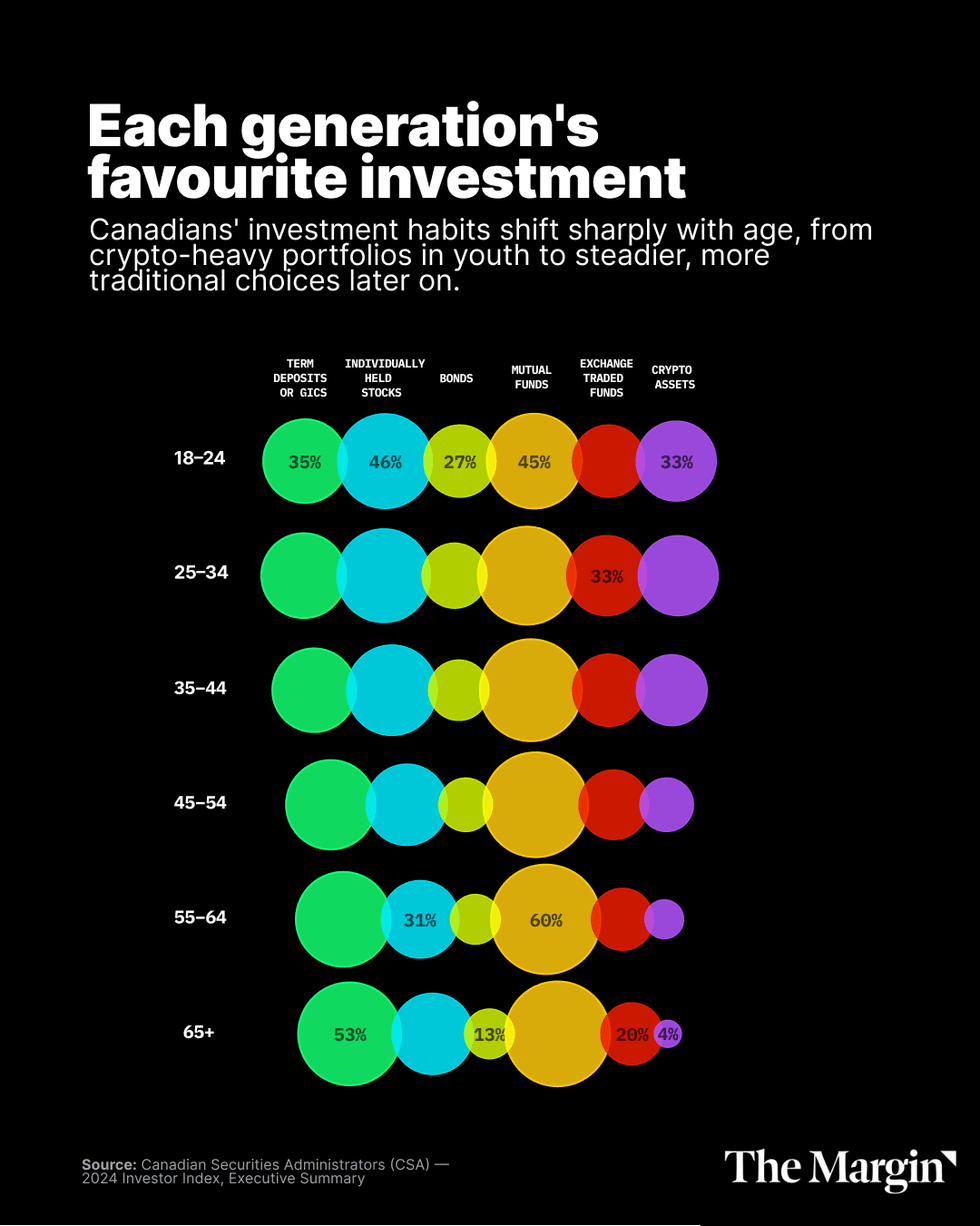
Crypto assets are an unusual favourite with Gen Z investors.
Data from CSA / Chart by Isabella Moura
Once they start investing, Gen Zs go for very different assets than their parents or grandparents. CSA data from 2024 shows that, while older Canadians seek refuge in transitional, predictable products like GICs, young adults opt for far more volatile securities. Their portfolios are dominated by individual stocks, and a third of young Canadians own cryptocurrencies, compared to just 4% of older adults. Not everything is a risky bet, though: nearly half of young investors also have money in a mutual fund. Still, the appetite for risk among young investors sets them well apart as a generation.
This isn’t so surprising. For one thing, investors with a longer time horizon can stand to take on more risk: it’s much easier to weather market swings when you won’t need your RRSP money for another 40 years. But there’s also something particularly Gen Z about having your stocks and crypto assets in the palm of your hand, on an easily accessible app. Indeed, the eagerness to see quick results through volatile investments reflects the very nature of screens, which prioritize dopamine hits above almost everything else.
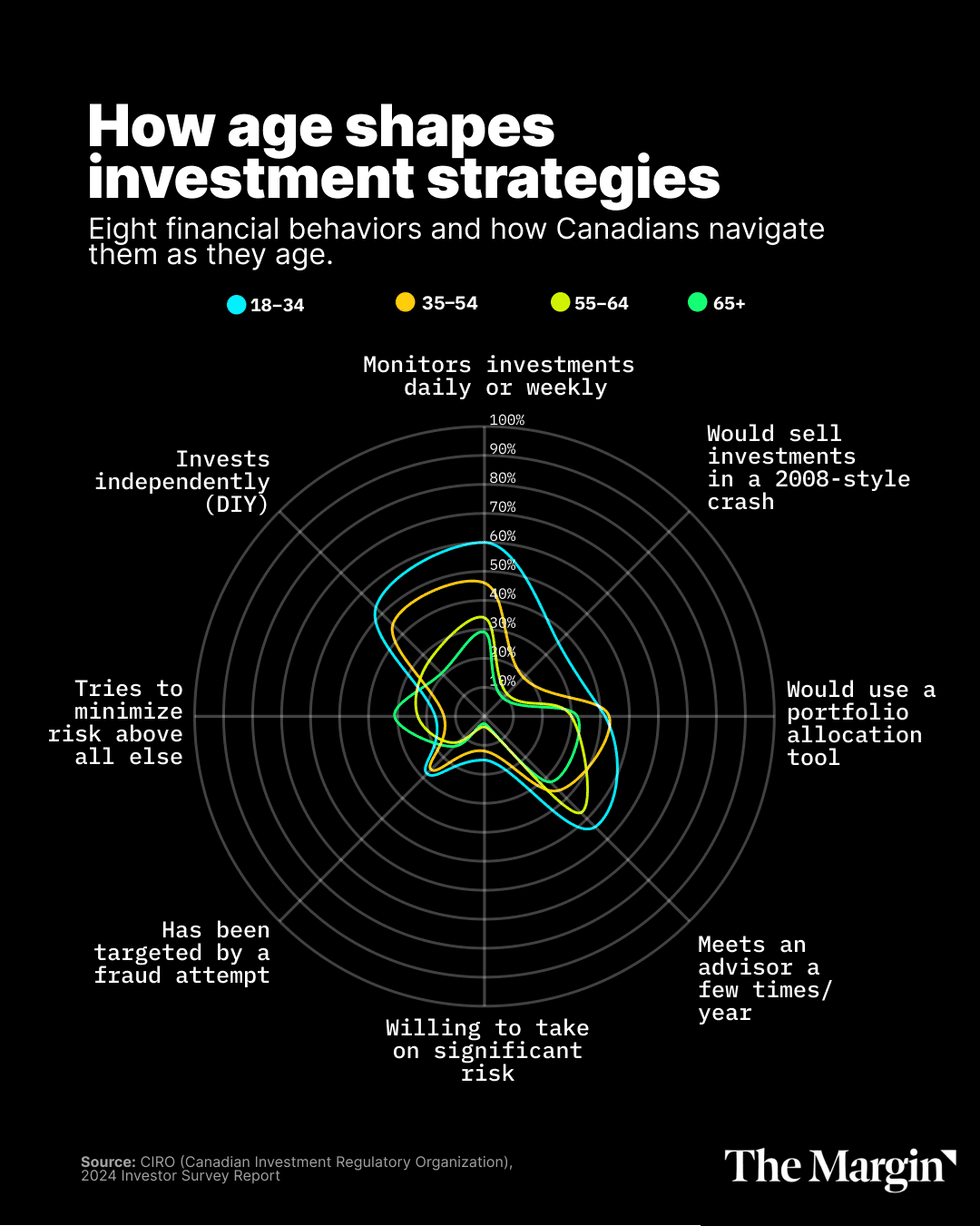
Data from CIRO / Chart by Isabella Moura
Young investors’ pursuit of quick gains has its downsides. For one thing, it makes them the primary target of scams and fraud attempts. As TIME magazine pointed out, the excessive amount of time they spend in front of screens and their reliance on the internet leave them even more vulnerable to digital dangers than older generations, who tend to be more wary of online offers. It also fosters a reactive mindset in the market: in times of stress – such as a sharp market decline along the lines of the 2008 crisis – younger investors’ inclination to sell everything immediately far exceeds that of more experienced investors.
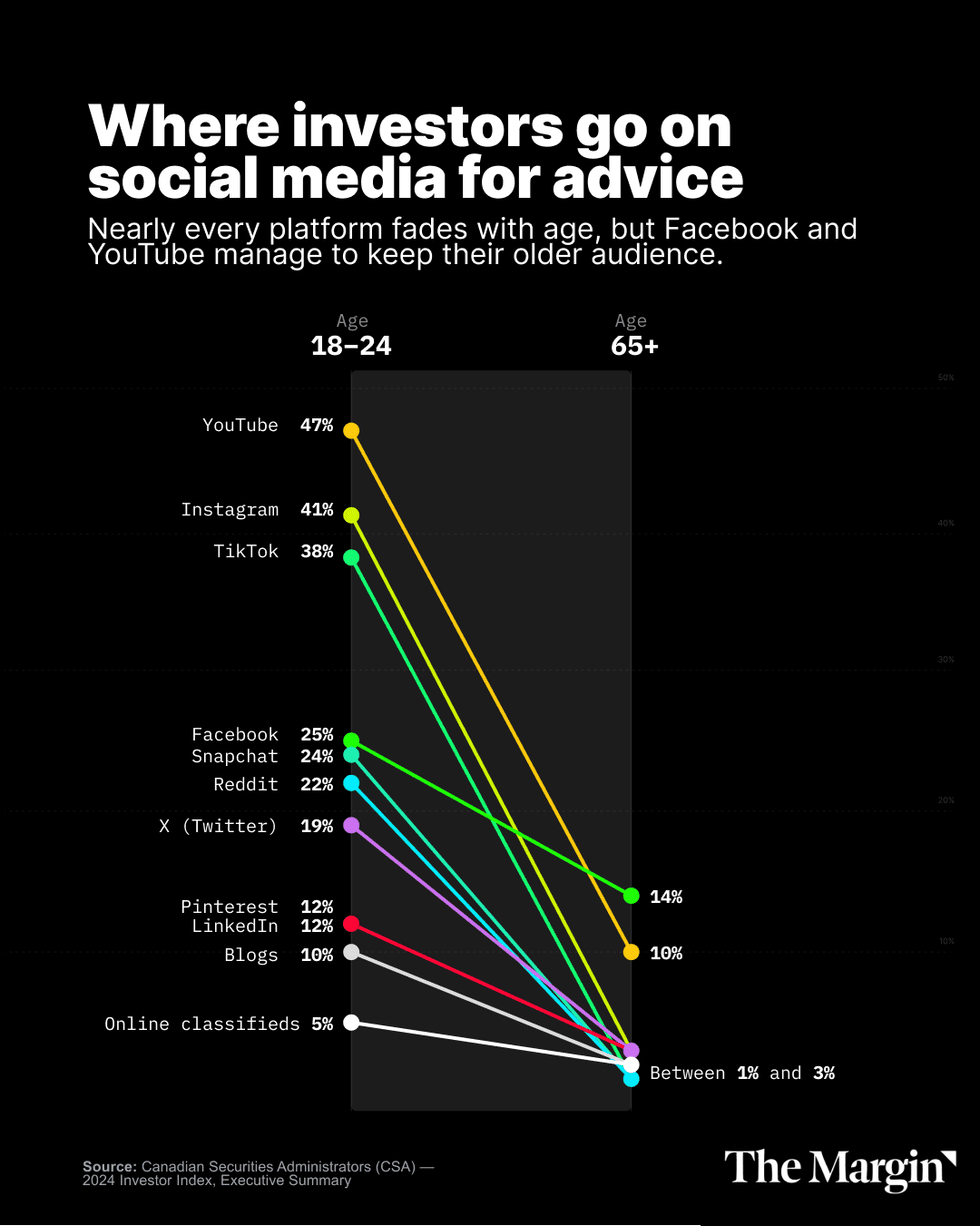
Data from CSA / Chart by Isabella Moura
Young investors’ flightiness is driven, in part, by a routine of constant monitoring. Two-thirds of Canadians aged 18 to 34 check their investments daily or weekly, popping open their investment viewer of choice as they cycle through their social media apps. And indeed, the two are not so different. Social media is itself a gateway to understanding money – or at least, to getting hot takes on it. CSA data shows over 80% of young Canadians use at least one social media platform to get information about investments.
The same cannot be said for their grandparents: only about a quarter of Canadians aged 65 or over use it for the same purpose (unsurprisingly, Facebook is their platform of choice). TikTok, on the other hand, highlights the generational divide; while it is the third most-used app among Gen Z, behind YouTube and Instagram, it’s virtually nonexistent among older users.
As the first generation to grow up with the internet, Gen Z are the canaries in the coal mine for how money will work in the digital age. Their habits make it clear that the new digital ecosystem has bridged the gap between investors and the market. This, in turn, has reshaped how investors make decisions. Young investors are operating with a new logic, in which the pursuit of autonomy, community validation, and the gratification of a ping on their phone take precedence over traditional institutional channels. The result is a less conservative – and possibly more volatile – market, driven by apps, digital assets, and a generation taking finance into their own hands.