
On Thursday, Nov. 16, the Carney government dropped its massive, 500-page-plus budget for the next year. For those unfamiliar with the process, this is where the feds announce all the goodies they’re going to buy in the year to come. It’s big on big-picture thinking, with lofty terms like the “Productivity Mega Deduction” and plans to “Supercharge Canada’s Investment Supercycle.” But hidden between the super-duper-superlatives are several plans that could have a real impact on young people. Here are the top five budget items that Gen Z should know about.
1. The feds want to build cheap housing, and a lot of it
The rent is too damn high, and the government knows it. This budget puts forward a three-pillared plan to build more houses, condos and apartments that Canadians can actually afford. One major bucket for these is affordable and non-market housing, and the feds are giving their in-house house building agency, Build Canada Homes, $13 billion to get on that, increasing its total money pot to $45 billion. That’s enough to build 200,000 new homes over the next 10 years, and 24,000 non-market homes each year – the kind that the average Joe can actually afford.
The feds also plan to juice the regular housing market, gearing it away from shoebox condos towards, well, the sorts of places people actually want to live in. They’re planning to offer $32 billion in loans to developers, which they claim will be enough to build 80,000 new rental units across the country. Apartment builders will also be subject to a GST break, incentivizing them to build.
We might also see more ‘missing middle’-style homes, which are small apartment buildings that slot in well to low-rise neighbourhoods. Right now, these are surprisingly difficult to build: not only do local zoning laws often prohibit them, but mortgage insurance rules also make them prohibitively expensive. The budget promises to tweak those mortgage rules, letting builders actually build.
All that could take time to kick in, even if builders break ground right away. But for people ready to buy, the budget promises an immediate $50,000 GST rebate on your first home – a nice break for anyone with enough cash for a down payment.
2. Mark Carney is personally begging you to become an electrician
This government really wants young people to go into the skilled trades. Its budget talks a lot about building things, and Liberal arts majors, while valuable, aren’t super useful there.
In the spring, the government announced ‘Team Canada Strong,’ a plan to give hands-on experience to 100,000 young people interested in the skilled trades. Each of these folks would be matched up with small- and medium-sized employers, who themselves stand to receive up to $10,000 to support each new hire.
These ideas have already been on the books since the Spring Economic Update, but this
budget is adding another four weeks of EI for apprentices in full-time training, making it less expensive to skill-up. On top of that, apprentices going through mandatory in-class training will get a $400 per week top-up on top of EI.
All told, the government is practically guaranteeing subsidized education and co-op placements for thousands of tradespeople. Even for those set on a university education, this may well be a route worth considering. Go become an electrician, bricklayer, plumber, ironworker, you name it – they’re literally begging you.
3. You could get some lunch money
Inflation has been out of control lately, and the government wants to help – albeit in a rather convoluted way. The Canada Groceries and Essentials Benefit was introduced earlier this year, and drops quarterly payments into eligible Canadians’ bank accounts, ostensibly to make up for the cost of groceries. This got a 50% boost in June and another 25% increase in July, and the new budget is increasing it by another 50% for 2027. For an eligible single person with no kids, that means $1,290 over next year.
But, like any government tax credit, there are caveats. For one thing, folks over a certain income threshold aren’t eligible, and what that actual threshold is depends on your family structure. If you earn more than that? Sorry, no lunch money for you. Here’s how it breaks down:
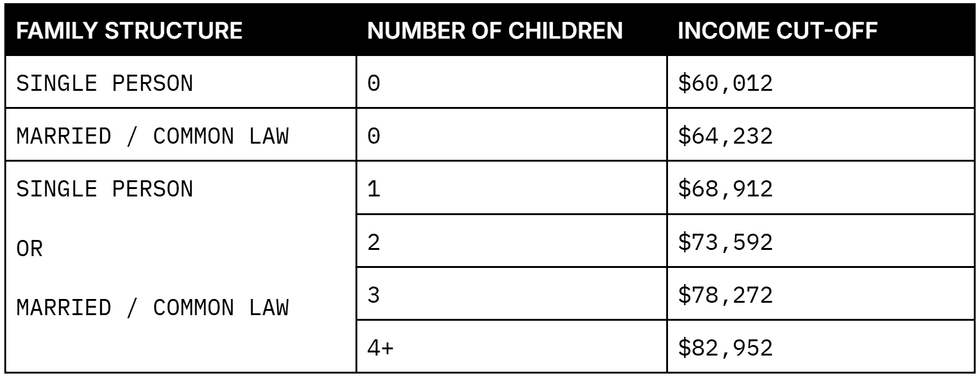
Income cut-offs for the Canada Groceries and Essentials Benefit.
The Margin staff
On top of all that, the benefit is distributed by the CRA, which means it’ll only apply to people who have done their taxes – so if you recently turned 18 and have been procrastinating on that, you’re leaving money on the table!
Speaking of which, the budget also includes measures to address that particular problem: every year, roughly 1.2 million low-income Canadians miss out on federal benefits by failing to file their tax returns. Last year’s budget allowed the CRA to start filing taxes for 3,000 people who had never done so before, and this year's budget allows them to reach out to another 50,000.
Still, if you’re eligible for these benefits, the fastest way to get them is just to do your taxes.
4. Regulations are coming for the chatbots
Both social media and AI chatbots could soon look a bit different, thanks to a proposed new government agency tasked with keeping the web safe for kids. Back in June, the government proposed Bill C-34, the Safe Social Media Act, which would make social media services like Instagram and AI chatbots like ChatGPT responsible for protecting their users from harmful content, with a special focus on children. A new arm of the government, the Digital Safety and Data Protection Commission of Canada (what a mouthful), would be the sheriff in town, keeping the internet giants honest with the threat of massive fines.
How exactly this would all work hasn’t been hashed out yet, but the budget gives the DSDPCC (the acronym is no better!) $176.4 million to get started. So far, we know that the government is concerned about harmful messaging on chatbots: the Act would mandate bots immediately stop conversations that steered towards topics of suicide, self-harm, or violence. Nor will they be allowed to manipulate users into becoming emotionally attached to their bot-friends or getting downright delusional. Users will also have the right to report issues to a real human being at the company responsible – no endless loops of AI customer service allowed.
Platforms will also be made responsible for rapidly removing any content that sexually victimizes a child, revictimizes a survivor, or contains content communicated without consent – including deepfake sexual images. They’ll also be made to flag AI-generated content, and give users the option to flag harmful content and block other users.
These regulations would apply to the big players on the internet, like Meta and Google, and come with massive fines for rule breaking. The Commission would be able to fine them for as much as 5% of their gross global revenue. For Google, that would mean US$20 billion per infraction.
This, too, will take a while: the government estimates it’ll take 18 months to get the new Commission up and running, and enforcement cases under similar laws in the EU have taken two years to get anywhere. In all likelihood, the kids this law would have protected will be grown adults before it does its job.
5. There's a bunch of freebies
Beyond the big ticket items, budgets tend to come with several scattered benefits for various groups, and several of these will be especially sweet for youths.
For anyone planning a cheap summer vacation (or some cozy winter camping), the Canada Strong Pass is returning for another year, providing free or discounted admission to national parks, along with museums, galleries and rail travel. Those discounts combine to make vacations in Canada more affordable. Plus, admission to all of Canada’s national museums will now be free for anyone under 25. (Most of these are in Ottawa, so the feds are basically saying “Come say hi.”)
Broke readers are also getting a boon: the government plans to create a digital library of books from Canadian authors. The collection will start with 200 titles in 2027-28, but it’s expected to grow to 2,000 titles over time. By 2031, the government hopes to be lending out over 2 million digital copies annually, each of which, we hope, will spark a fresh hot take on Book Tok.
For anyone fed up with finding work in their hometown, the feds have your back. There was already a tax credit for anyone who packs up for a new job, and it lets them deduct their moving costs from their taxes. But it also required them to keep all their receipts and prove every amount, and moving is a hassle as it is. The new budget provides an easier way: just inform the government you moved for work, and you can instantly deduct $1,000 from your taxes. Tradespeople get an even better deal: they can claim up to $10,000 for a temporary relocation (with receipts) or simply deduct $1,500 flat. (Note that couples can’t double dip: if you both move together, only one of you gets the benefit.)
Finally, clever students will be able to keep more of their scholarships. Right now, scholarships, bursaries, and grants aren’t tax free if the student also gets money from an “arm’s-length person,” such as an employer. The budget changes this: starting in 2027, scholarship-worthy students won’t be penalized for working on top of getting amazing grades. It’s a good time to be a keener.